

Key points:
- The Africa Central Conference elected the Rev. Gift Machinga as a United Methodist bishop on the 12th ballot.
- He was the third bishop elected March 15 by the central conference, which is scheduled to split into the new East Africa and Southern Africa central conferences.
- Last year’s General Conference elected Machinga as a member of the Standing Committee on Central Conference Matters.
The Rev. Gift Kudakwashe Machinga, a pastor in Zimbabwe, has been elected as a United Methodist bishop by the Africa Central Conference.
Machinga, 61, was elected March 15 by delegates meeting in Johannesburg. On the 12th ballot, he received 41 votes out of 60 valid votes cast; he needed 40 to be elected.
“I extend appreciation to my siblings in ministry: the Rev. Forbes Matonga, the Rev. Lloyd Nyarota and my sister the Rev. Vienna Mutezo. I respect you and I embrace you,” Machinga said upon his election, in reference to his fellow candidates from Zimbabwe.
“I invite the Zimbabwe Episcopal Area, both clergy and laity, to journey with me as we take The United Methodist Church to another level.”
Machinga was the third bishop elected in the central conference. The Rev. Emmanuel Sinzohagera of Burundi was elected on the first ballot, and the Rev. Moisés Bernardo Jungo of Angola was elected on the ninth ballot.
After consecration March 16, Machinga was assigned to the Zimbabwe Episcopal Area. He succeeds Bishop Eben Nhiwatiwa, who is retiring. The episcopal area includes the Zimbabwe East and Zimbabwe West conferences. In the Africa Central Conference, bishops are elected to a four-year term and if re-elected, they can serve for life.
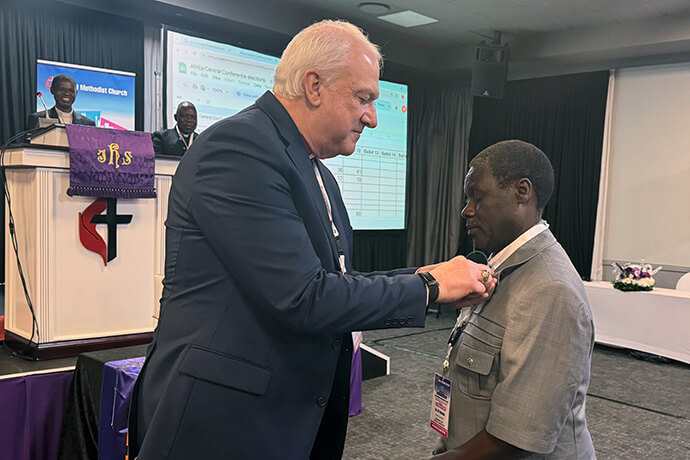
On March 16, the Africa Central Conference also split into the East Africa and Southern Africa central conferences. Each central conference will consist of multiple annual conferences, associations of United Methodist congregations and other ministries.
- The East Africa Central Conference will consist of the United Methodist presence in Ethiopia, Kenya, Rwanda, South Sudan and Uganda. The new central conference also will include Burundi, which, after more than a decade of internal divisions, fully reunited with The United Methodist Church in 2018.
- The Southern Africa Central Conference will consist of the United Methodist presence in Angola, Botswana, Madagascar, Malawi, Mozambique, Namibia, Eswatini (formerly Swaziland), South Africa and Zimbabwe. Machinga's area is part of the newly created Southern Africa Central Conference.
Machinga has 42 years of experience in pastoral ministry. He currently serves as pastor in charge of the Zimre Park United Methodist Church in the Zimbabwe East Conference. Last year, General Conference — the denomination’s top legislative assembly — elected him as a member of the Standing Committee on Central Conference Matters, a permanent General Conference committee that deals with issues affecting United Methodists in Africa, Europe and the Philippines.
He previously has served as a pastor of United Methodist churches across Zimbabwe and as a district superintendent, helping the bishop in making pastoral appointments. He also has served as a conference secretary, chair of the board of ordained ministry, chair of the board of discipleship and chair of the Bishop Ralph Dodge Scholarship Fund. At the general-church level, he also has been a board member of Africa Upper Room Ministries.
Subscribe to our
e-newsletter
Machinga has been an adjunct lecturer on Christian education and chair of the council at United Theological College, an ecumenical Protestant seminary in Zimbabwe. He also has served as the United Methodist representative to the Christian Care Ecumenical Organization and chair of the Church Community Police Network in Zimbabwe. Early in his ministry, he served pastoral appointments in the United States.
He has a diploma in theology, a master’s in religious education and a Doctor of Ministry degree.
In his candidacy for bishop, Machinga wrote that he wants to help United Methodists navigate change and challenges in the denomination, especially after last year’s General Conference ended denomination-wide bans on gay clergy and same-sex marriage. Central conferences now can set their own policies with regard to ordination and marriage.
“My perspective on marriage and sexuality is shaped by Scripture and rooted in my cultural and traditional Zimbabwean values,” Machinga wrote in his biographical materials. “While I uphold Biblical teachings that define marriage as between a man and a woman, I also recognize the importance of extending ministry to all individuals.”
Machinga is married to Mazvita Machinga, a United Methodist chaplain and psychotherapist who leads a pastoral counseling service. The couple has two daughters.
The United Methodist Church has eight central conferences — church regions in Africa, Europe and the Philippines — with Southern Africa and East Africa as the newest additions. Central conferences, which each consist of multiple annual conferences, elect bishops and have the authority to adapt parts of the Book of Discipline, the denomination’s policy book, as their missional contexts require.
In The United Methodist Church, bishops are ordained elders who are called to “lead and oversee the spiritual and temporal affairs of The United Methodist Church.”
Bishops are responsible for appointing clergy. They also are the first stop when clergy face complaints under church law. They also serve as board members or chairs of general agencies and other denomination-wide ministries.
Chikwanah is a UM News correspondent based in Harare, Zimbabwe.
News media contact: Julie Dwyer at (615) 742-5470 or newsdesk@umnews.org. To read more United Methodist news, subscribe to the free UM News Digests.

