

Key points
- A United Methodist deaconess/home missioner consecration service was held in Africa for the first time, marking the beginning of a movement on the continent.
- Leah Wandera, the first deaconess from the Kenya-Ethiopia Conference, is now the Africa Region coordinator for the Deaconess/Home Missioner Office, supported by United Women in Faith.
- Fifteen candidates were consecrated — with ministries including education, environmental justice, elder care, digital literacy — and Wandera said more are coming.
Writing a new chapter in the story of faith, justice and service in Africa, 15 deaconess and home missioner candidates were consecrated in Tanzania.
The event marked the official launch of the Africa Region Deaconess/Home Missioner Movement of The United Methodist Church.
Hosted in collaboration with the Diakonia World Federation Assembly and the Africa Region Deaconess/Home Missioner Office, the event — held July 8-12 at the Lutheran Uhuru Hostel and Conference Centre — signaled not just the birth of a movement, but also a long-awaited realization of a diaconal vision rooted in African faith and identity.
The consecration service was a spirit-filled celebration of commitment, healing and social holiness. It marked the first time for a United Methodist deaconess/home missioner consecration on African soil, witnessed by a diverse international gathering from 26 nations.
At the heart of the movement stands Leah Wandera. In 2021, after completing her candidacy process in the United States, she became the first United Methodist deaconess from the Kenya-Ethiopia Annual Conference. She now serves as Africa Region coordinator for the Deaconess/Home Missioner Office, supported by United Women in Faith.
“When God called me to be a deaconess,” Wandera recalled, “I didn’t even know such a path existed for someone like me — an African woman, shaped by community, faith and a deep longing to serve. But once I stepped into that call, I couldn’t keep it to myself. I began to share, to pray and to invite others because God is raising up many across Africa with hearts ready to serve in love, justice and compassion.”
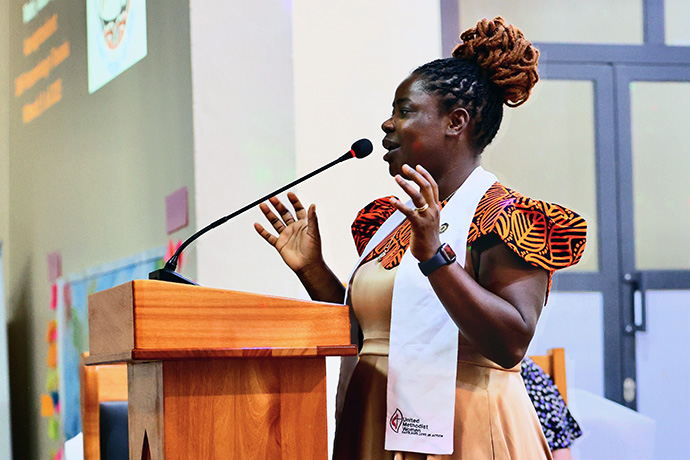
Wandera’s words have not gone unheeded. Through her outreach — particularly to alumni of the United Methodist Board of Global Ministries’ Global Mission Fellows program — dozens have stepped forward to embrace the vocational call of deaconess and home missioner.
On a cool evening in Moshi, surrounded by the global diakonia community, the new deaconesses and home missioners were consecrated in a worship service led by Bishop Joaquina F. Nhanala, retired bishop of the Mozambique Episcopal Area.
Subscribe to our
e-newsletter
The candidates entered the sanctuary to the song “When He Calls Me, I Will Answer,” led by Home Missioner Tinashe Tembo of Zimbabwe, the first African home missioner, consecrated in 2022.
“Tonight marks the official start of the Deaconess and Home Missioner Movement in Africa,” Tembo said. “May the movement foster a commitment to diaconal vision rooted in the experience, gifts and vision of the African people and the African church.”
Among those joining the celebration were 16 deaconesses/home missioners from the U.S., seven from the Philippines, and a United Methodist deacon from the U.S., all representing a shared global commitment to diakonia — service rooted in love, justice, compassion and peace.
The milestone is the fruit of persistent hope and cross-continental collaboration. Visa challenges hampered efforts to include African candidates in a 2024 consecration at General Conference in Charlotte, N.C. During that event, three African candidates from Malawi, Tanzania and Zimbabwe were consecrated.
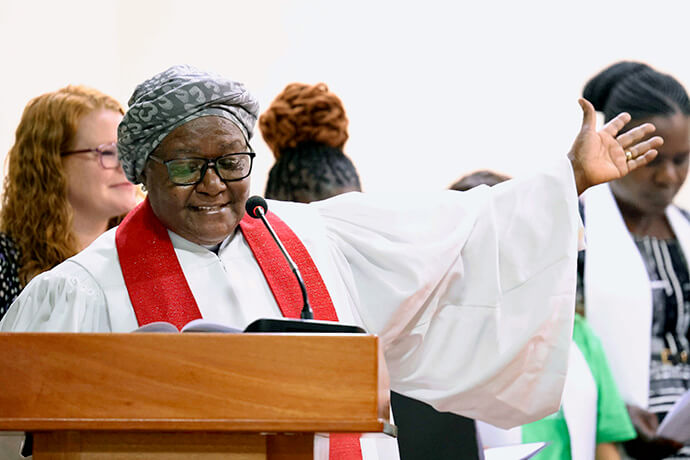
When Wandera and Deaconess Megan Hale, executive for the U.S.-based Office of Deaconess and Home Missioner, approached the global Diakonia World Federation Assembly leadership with the idea of an African consecration, they were supported enthusiastically.
“The church is not the church without diakonia,” said the Rev. Deacon Sandy Boyce of Australia, Diakonia president. “The work of diakonia is not for the faint of heart. Our vocation requires continual discernment and prayer.”
Workshops, Bible studies and cultural performances filled the week, led in part by the Africa Region Deaconess and Home Missioner Cohort. Topics included environmental justice, trauma healing, reproductive health and food security — highlighting the diversity of African ministry contexts.
Each newly consecrated deaconess and home missioner brings unique gifts and a commitment to contextually grounded ministry. Their ministries span education, environmental justice, elder care, digital literacy and more.
“This is not just a title — it’s a calling,” said Home Missioner Eli Chacha Thomas of Kenya. “A holy commitment to walk with the hurting, speak hope to the weary, plant seeds of peace and serve faithfully where Christ leads.”
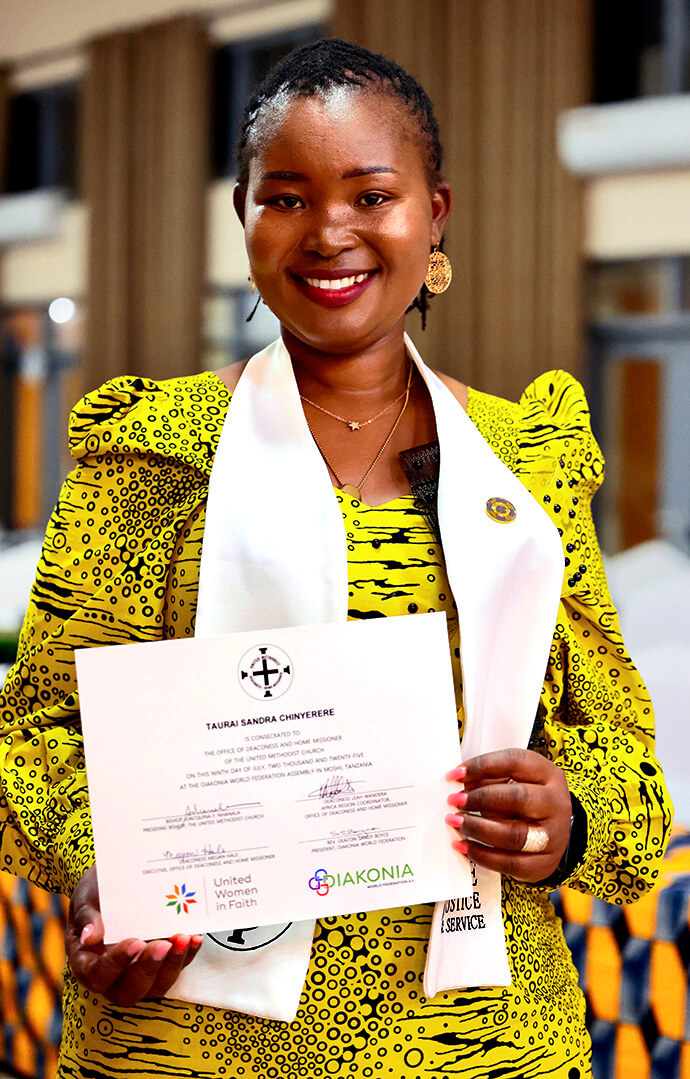
Following the consecration, Wandera shared that 28 additional African candidates are currently in formation, including 11 French-speaking candidates from the Democratic Republic of Congo and Côte d’Ivoire.
Seven African young adults from Kenya, Zimbabwe, Sierra Leone and Liberia also are now studying at Harris Memorial College in the Philippines — a historic deaconess training school — with full scholarships provided by United Women in Faith. Graduates will receive bachelor’s degrees and meet deaconess and home missioner training requirements by 2027-2028.
Additionally, three candidates are pursuing studies at Africa University, and two others have graduated from nursing programs in Kenya.
As the newly consecrated deaconesses and home missioners processed out of the sanctuary singing “Siyahamba/We Are Marching,” the message was clear: Africa is rising to the call of diakonia.
“This movement is deeply African,” said Tembo. “Our service is premised on spirituality, transformative social action and authenticity.”
At the reception, Wandera proclaimed, “You see 15 up here today, but there are more coming.”
Maiga ispastor of United Methodist Church of Albert Lea in Albert Lea, Minnesota.
News media contact: Julie Dwyer at newsdesk@umnews.org. To read more United Methodist news, subscribe to the free UM News Digest.


