

Key points:
- Carlos Chavez, a Mexican-born member of North Hills United Methodist Church Hispanic Mission in Los Angeles, was apprehended Jan. 29 at the church and deported shortly thereafter.
- The D.C. Court of Appeals heard oral arguments Feb. 5 for a lawsuit filed by religious organizations claiming that a 2025 policy change that rescinds a long-time policy to avoid disrupting churches and schools is unconstitutional.
- A decision from the court is expected to take about two months.
United Methodist Carlos Chavez was motivated by his need for health care to sign a waiver that led to his immediate deportation after he was arrested Jan. 29 at North Hills United Methodist Church Hispanic Mission in Los Angeles, said an immigration attorney.
Meanwhile, 2,300 miles away in Washington on Feb. 5, a lawyer representing more than two dozen religious organizations — including four United Methodist bodies — sparred with a federal government attorney over how church attendance is being affected by an aggressive new U.S. Immigration and Customs Enforcement policy justified by an executive order by President Trump.
The memo put an end to the long-standing federal “sensitive locations” policy under which law enforcement officers were directed to avoid disrupting houses of worship, hospitals and schools unless there are exceptional circumstances.
Chavez, an undocumented immigrant from Mexico, is an example of the consequences of the new policy.
A member of North Hills United Methodist Church Hispanic Mission, he was apprehended by ICE agents at the church on Jan. 29 while it was distributing food, and “mothers, young children and youths” were tending the church garden, according to a statement from the church.
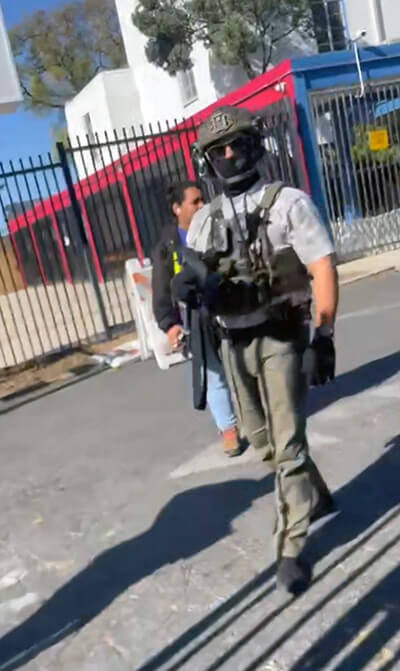
“Places of worship should be safe for everyone,” said Bishop Dottie Escobedo-Frank of the California-Pacific Conference. “Our conference felt that safety broken last month when a food ministry at North Hills Hispanic Mission was disrupted by the arrest of Carlos Chavez.
“When I visited (Feb. 8), I saw a community shaken but courageous. As we walk together toward healing, we urge leaders in Washington to hear our pain and reconsider the sensitive locations policy so all may worship without fear.”
Chavez suffers from a respiratory illness, said Monalisa S. Tu’itahi, the immigration coordinator of the California-Pacific Conference. She said she got that information from Chavez’ wife.
“What I’ve been told is that he needed attention to that medical issue, and he was told ‘no,’” she said. “I’m sure that caused him to just sign (a waiver) and he did go and get some medical help in Tijuana.”
According to Tu’itahi, Chavez also told his wife during a phone call that ICE officials believe they know where to find her.
“If she doesn’t fix her status, they’re going to come for her, too,” she said. “The wife is really, totally in fear.”
The couple’s 21-year-old daughter, a U.S. citizen, can file petitions in her father’s case, which might help his situation down the road, Tu’itahi added.
Similar experiences are likely to befall other congregations under the current ICE policy, according to the complaint filed by the religious organizations, which says houses of worship are already seeing declines in attendance.
Among the signatories to the lawsuit are The United Methodist Church entities the Commission on Religion and Race, New York Conference, North Georgia Conference and the Western North Carolina Conference. Also represented in the lawsuit are Mennonite, African Methodist Episcopal Zion, Jewish, Christian Church (Disciples of Christ), Church of the Brethren, Episcopal, Presbyterian and Unitarian faiths.
What happened at North Hills United Methodist Church shows the harm caused by the current policy and why the lawsuit is necessary, said the Rev. Giovanni Arroyo, the top executive of the United Methodist Commission on Religion and Race.
“The recent ICE engagement at North Hills United Methodist Church has caused deep collective trauma within the community,” he said. “Entering church property while masked and armed represents an unacceptable enforcement practice and a violation of the sanctity of sacred space.”
He added that churches have long served as centers of safety and support for both immigrants and non-immigrants.
“They are spaces where people seek refuge, spiritual care and dignity,” he said. “Actions that instill fear within these sacred spaces undermine the trust they are meant to provide and inflict lasting harm on already vulnerable communities.”

The lawsuit, “Mennonite Church USA vs. U.S. Department of Homeland Security,” was originally filed in the U.S. District Court, District of Columbia, in February 2025, seeking an injunction to prevent federal agents from carrying out immigration enforcement activities at places of worship and to stay the effective date of the Rescission Memo. That motion was denied in April 2025 and an appeal was filed.
“Before reversing longstanding policy, an agency must recognize that it is changing course, reasonably explain its rationale for adopting the new policy, consider reliance interests that the previous policy may have engendered, and grapple with alternatives,” the complaint reads. “DHS made no attempt to engage in such a considered approach.”
Help for North Hills church
North Hills United Methodist Church Hispanic Mission was forced to halt their food ministry after ICE officers came onto their property. The church created a fundraising account to provide emergency assistance to families affected by immigration enforcement and to help improve the security of their property.
To donate online, visit this link
Because of the policy change, “plaintiffs began experiencing substantial attendance declines at their places of worship,” said attorney Kelsi Corkran during oral arguments Feb. 5 before a three-judge panel of the U.S. Court of Appeals for the D.C. Circuit. Corkran is representing the religious institutions.
“Immediately after (the Department of Homeland Security) announced the policy change with a widely reported press release explaining that the prior sensitive locations policy tied the hands of ICE and (border) officers, whereas the new unrestricted policy would empower them to go after undocumented immigrants at places of worship,” Corkran said.
“Plaintiffs submitted dozens of declarations from pastors and rabbis attesting to their attendance declines and attributing them to fear among congregants and ministry participants that ICE and (border agents) would engage in enforcement activity at their places of worship under the new policy,” she added.
Attorney Michael Talent, who represents Homeland Security, argued that few raids of churches and synagogues had actually occurred, arguing the fear cited by the religious organizations was unfounded.
“They claim these enforcement actions are imminent,” Talent said. “This could allow enforcement at worship services, but it just hasn’t manifested.
“They still need to show that there’s going to be an imminent enforcement action at that church in the future,” Talent argued. “And there’s nothing that they have provided in the record and there’s nothing that they've tried to bring in outside the record to this court to illustrate that.”
Judges pointedly questioned some of Talent’s statements.
“It seems to be a little bit of an interesting argument for the government to say … we’re ramping up enforcement everywhere, we are going to remove a barrier to enforcing at places of worship, but the court should presume that by doing so, even though we’re enforcing everywhere, we’re not going to enforce at places of worship where we just removed the barrier to enforcement,” one member of the three-judge panel remarked.
Subscribe to our
e-newsletter
Talent countered that a better case could be argued if “a DHS official appeared at a church one day to arrest someone.
“That person wasn’t there, and they told the pastor, ‘I'm going to come back until this guy shows up.’ I think that would make their case a lot stronger. … They don’t have that example.”
The Rev. Jennifer Gutierrez is executive director of Clergy and Laity United for Economic Justice, an interfaith advocacy group in California that works on economic and social justice issues. Gutierrez, who is United Methodist, said the ICE policy making it easier to enter houses of worship already has been “extremely detrimental” to places of worship.
“People are afraid to go to their church, to worship, to be together in community, to pick up food,” she said. “I’m aware of congregations that limited their community celebrations around the holidays because they were worried that there might be ICE enforcement.”
The religious organizations are asking for a declaration that the new policy violates the Religious Freedom Restoration Act and First Amendment rights of congregations and their members and “setting aside, vacating, and remanding” the 2025 Rescission Memo.
A decision from the U.S. Court of Appeals for the D.C. Circuit is expected to take about two months.
Patterson is a reporter for UM News. Contact him at (615) 742-5470 or newsdesk@umcom.org. To read more United Methodist news, subscribe to the free UM News Digest.


