

Key points:
- U.S. funding cuts could reverse the progress made in fighting AIDS in Africa, according to participants attending a workshop on HIV prevention in Kenya.
- The church must advocate for compassion and care for marginalized people, said the Rev. Sunny Brown Farley, coordinator of the United Methodist Global AIDS Committee.
- In Rwanda, Farley helped dedicate two homes that the committee built for women living with HIV.
“Horrible.” That was the one-word reply of a tearful young lesbian woman when asked about her experience working with churches in Kigali, Rwanda. She works as an advocate for stigmatized people living with HIV.
In response, the Rev. Sunny Brown Farley identified herself as a pastor and apologized for homophobia in the church. She affirmed God’s love for all people regardless of sexual orientation or health status. From Tyler, Texas, Farley is coordinator of the United Methodist Global AIDS Committee, which provides resources and training to annual conferences and local churches, engaging them in HIV and AIDS education and advocacy.
The episode symbolized one of multiple encounters Farley experienced as she met with Christians in Kenya and Rwanda during her visit July 8-21 to Africa on behalf of new initiatives by the United Methodist Global AIDS Committee. Bishop Cedrick D. Bridgeforth, leader of the Greater Northwest Episcopal Area, is chair of the international committee.
In Kenya, Farley headlined a two-day workshop designed to educate United Methodist pastors and laity on how to provide HIV prevention, care and treatment. Leadership was provided by the Rev. Kennedy Mwita, pastor of First United Methodist Church in Moheto, along with local HIV activists and persons living with HIV.
In 2019, First United Methodist Church Moheto voted to become the first congregation in Africa to identify as reconciling. This means the church is connected with over 1,300 other reconciling churches and communities around the world (including at least two others in Kenya) that fully welcome and affirm LGBTQ people in the life of the church.
Faced with the sudden demise of the United States Agency for International Development and uncertainty over impending cuts in U.S. funding for lifesaving medications through the President’s Emergency Plan for AIDS Relief, participants expressed fear that progress toward ending AIDS would be reversed and the days of widespread suffering and death in sub-Saharan Africa would return.
“In the face of America’s looming broken promises to fight AIDS, hunger and poverty, the church must be an advocate for compassion and care for the world’s most marginalized and impoverished,” Farley said. “In every place we need to tell the Gospel story of feeding the hungry and caring for the widow and orphan.”
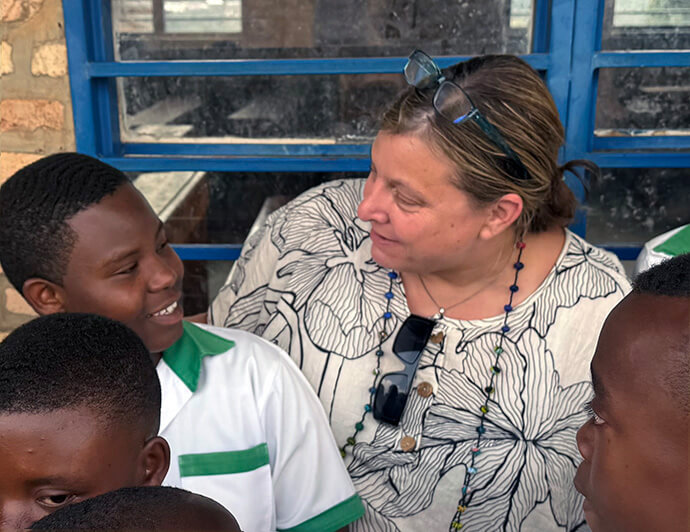
Farley’s journey in Rwanda was highlighted by helping dedicate two $6,000 homes that the United Methodist Global AIDS Committee built for women living with HIV.
One of the women, along with her five children, was plunged into poverty after her husband died of AIDS. She and her children barely survived in a wooden shack meant to house goats. The mother expressed profound appreciation that “someone somewhere cared.”
Subscribe to our
e-newsletter
Outside the home, grateful Rwandans planted a eucalyptus tree in memory of Farley’s late husband, Jim, who died after a 16-month struggle with glioblastoma, an aggressive brain cancer, in March.
At two educational institutions, Farley was surrounded by young people involved in anti-HIV school clubs.
“With the ever-present threat of HIV, providing sexual health education for youth is a high priority for our church and country,” reported the Rev. Augustin Bahati, treasurer of the United Methodist Rwanda Provisional Conference and executive director of the Inclusive Mission for Health and Hope in Rwanda.
At a Rotary Club in Geysini, Rwanda, Farley spoke with local leaders about building bridges between secular and religious groups to promote HIV prevention. Along with Justin Levy, executive director of the Center for Health and Hope in Denver, they pledged to mobilize new educational and fundraising initiatives.
Funding for the trip and programs was provided by a grant from The Permanent Endowment Fund of Moody Methodist Church, Galveston, Texas.
Messer, of Centennial, Colorado, is secretary of the United Methodist Global AIDS Committee and founder of the Center for Health and Hope.
News media contact: Julie Dwyer at newsdesk@umnews.org. To read more United Methodist news, subscribe to the free UM News Digest.


