
Key points:
- An English edition of a Korean United Methodist small-group curriculum on Jesus’ parables is expanding its reach.
- The Rev. Timothy Myunghoon Ahn’s “He Spoke to Them Using Parables: The Parables of Jesus” combines a Scripture passage with interpretation and application, followed by reflection and prayer.
- In 2024, a reported 570 Korean pastors were serving cross-racial/cross-cultural appointments, out of approximately 850 Korean American pastors serving United Methodist churches and extension ministries.
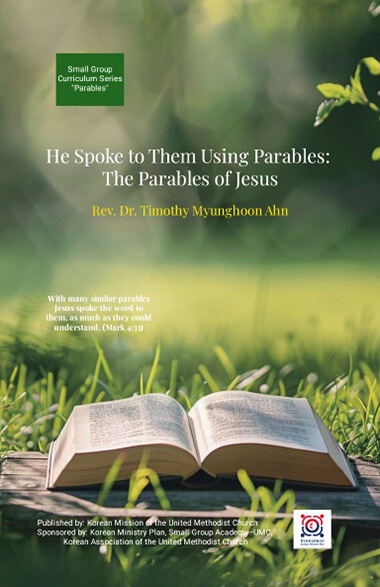
When Korean pastors serving English-speaking congregations outside the Korean community received copies of a Korean-language small-group curriculum on Jesus’ parables, many had the same question: Could it be made available in English for their congregations?
Their interest helped set in motion an English translation for the Rev. Timothy Myunghoon Ahn’s “He Spoke to Them Using Parables: The Parables of Jesus.”
“At the 2025 convocation of the Korean Association of The United Methodist Church, many pastors serving English-speaking congregations who received the Korean version told me, ‘We wish this resource were available in English so our congregations could use it, too,’” Ahn said. “That led us to translate the curriculum into English.”
Each lesson combines a Scripture passage with interpretation and application, followed by reflection, discussion questions, shared prayer concerns and a closing prayer.
For example, the first lesson, on the hidden treasure in Matthew 13:44, invites participants to reflect on the “treasures” they have discovered in Scripture and share how their faith has helped them through difficulties.
Published by the Korean Mission of The United Methodist Church and sponsored by the Korean Ministry Plan, Small Group Academy-UMC and the Korean Association of The United Methodist Church, the English edition is available in paperback through Lulu.com.
The original Korean curriculum was introduced in 2025 as a resource for sokhoe, the Korean term for the Methodist class meeting, with detailed guidance intended to help even relatively inexperienced leaders guide small groups through Scripture.
How to order
“He Spoke to Them Using Parables: The Parables of Jesus” is available in paperback through Lulu.com.
The English edition retains that connection to the Methodist class-meeting tradition. Its introduction describes the class meeting as a “small church within the church,” where members share the Word, encourage one another’s spiritual growth, develop fellowship and extend their ministry into mission.
Ahn, who has served local churches for many years and holds a doctorate in Christian education from Boston University, said accessibility was one of his primary concerns.
“Throughout the writing process, I kept asking how I could interpret Jesus’ parables as simply as possible,” he said. “After all, one of the main reasons Jesus used parables was to explain the profound truths of heaven in a way people could easily understand.”
That approach is explained in the book’s preface. Ahn writes that Jesus used parables to teach heavenly truths in a way that matched the listeners’ “eye level,” enabling them to understand what otherwise might seem difficult or mysterious.
“One of the most common responses I hear from people using the curriculum is that it makes Jesus’ parables very easy to understand,” Ahn said. “My sincere hope is that this resource will help both Korean- and English-speaking Christians grow spiritually.”
The Rev. Prumeh Lee, who translated the curriculum into English, said that the combination of accessibility and theological substance is one of the book’s strengths.
“I deeply appreciate that the author … intertwines his biblical knowledge with his many years of experience as a pastor,” Lee said. “The Bible study is not complex and is accessible to all Christians. However, there is also a great depth to his insights.
“I suppose the book itself is like a parable of Jesus: theology and profound truths made simple to understand.”
The Rev. Paul H. Chang, executive director of the Korean Ministry Plan, said the English edition is significant both for the plan’s longstanding emphasis on small-group ministry and for Korean American United Methodists, who increasingly minister in both English and Korean.
“First, it serves as a small-group resource, an area the Korean Ministry Plan has consistently emphasized. Second, it provides an English-language resource for the Korean American community in North America, which is increasingly becoming bilingual, using both Korean and English,” he said.
That need extends well beyond Korean-language congregations. In 2024, Chang reported that 570 Korean pastors were serving cross-racial/cross-cultural appointments, out of approximately 850 Korean American pastors serving United Methodist churches and extension ministries.
The Rev. Miso Park, president of the National Association of Korean-American United Methodist Pastors Serving Cross-Racial/Cultural Appointments, said that reality makes resources such as Ahn’s particularly useful.
“Many of us lead English-speaking congregations and need good Bible study resources that are easy to use with our members,” Park said. “This book offers 20 lessons on Jesus’ parables, with helpful background, interpretation, reflection and discussion questions, plus a closing prayer.”
Park said the Korean and Korean American perspectives retained in the English edition also can be an asset in cross-cultural ministry.
“I appreciate that it incorporates Korean and Korean American cultural perspectives, which can bring a different perspective to cross-cultural conversations,” she said. “I believe this book can be useful not only for Korean American pastors, but for any pastor or congregation who wants to study Jesus’ parables together in a meaningful way.”
Preserving that cultural perspective was an intentional choice for Lee.
Ahn had told her she could replace Korean hymns, songs and cultural references with more familiar English-language ones. But as Lee worked on the translation, she decided that making the book accessible in English did not require stripping away the Korean context that helped shape it.
Subscribe to our
e-newsletter
“When I translated the beautiful Korean hymns and songs into English, I realized that I wanted non-Koreans to also read and hear the witness of the Korean faith,” Lee said. “Although uniquely Korean in some ways, I believe that anyone reading the translated lyrics would see that songs can speak across cultures and languages.”
She made a similar decision when encountering Korean historical references in Ahn’s writing.
“I didn’t want to change the context of these references because I felt that these examples were an expression of Rev. Ahn’s Korean American identity,” she said.
For Lee, the popularity of Korean American stories such as the film “Minari” illustrates how a story can retain its particular cultural identity while connecting with people from other backgrounds.
“This Bible study is unapologetic in being rooted in Korean American Christianity, but it can absolutely be used in any cultural or language context,” she said, pointing out that Christians still find meaning in Jesus’ parables told 2,000 years ago.
Lee also sees a distinctly United Methodist value in the curriculum. While many Bible studies are available, she said it can be difficult to find resources specifically designed for small groups in United Methodist congregations.
“This book is written specifically for small groups in a United Methodist church,” she said, “so the discussion and the flow of each chapter is natural and fits so well structurally and theologically to UMC small-group ministries.”
Chang said the book was intentionally designed to be flexible.
“It can be used not only as a small-group curriculum, but also for Bible study, daily devotion and sermon preparation,” he said.
For Lee, the English edition also has a much more personal audience.
She and her husband are both clergy, but like many Christian parents, she wonders whether they are doing enough to nurture their children’s faith. Their children are third-generation Korean Americans and are not fluent readers or writers of Korean. She hopes the English translation will allow the faith and spiritual wisdom embedded in a Korean American resource to reach that generation as well.
“I hope to use this book for our family as part of our weekly devotion,” Lee said. “I hope that through this translation, my children can also receive spiritual guidance from this beautifully written Korean American Bible study.”
Kim is director of Korean and Asian news at United Methodist Communications. Contact him at 615-742-5470 or newsdesk@umnews.org. To read more United Methodist news, subscribe to the free UM News Digest.


