
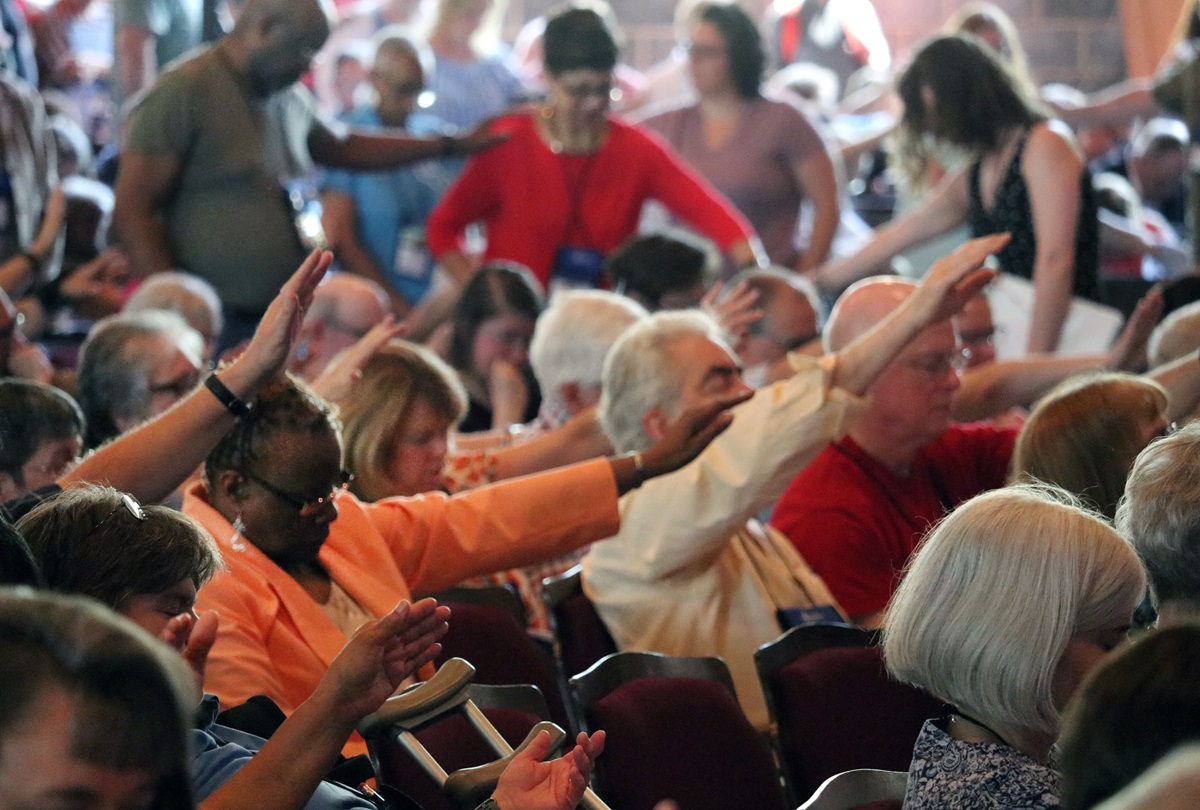
Several United Methodist annual conferences meeting this summer looked at plans for a new Methodism centered around how to divide The United Methodist Church.
More than 20 of the regional gatherings rejected the Traditional Plan approved by the 2019 General Conference and voted to remove the phrase “homosexuality is incompatible with Christian teaching” from the denomination’s lawbook. The United Methodist Church has 54 U.S. regional conferences that meet in May and June.
Other conferences had passionate discussions about the future of The United Methodist Church but stood by the action of the 2019 General Conference.
The Book of Discipline, the United Methodist policy book, says that the practice of homosexuality “is incompatible with Christian teaching,” and bars “self-avowed practicing homosexuals” from ordination. Despite passage of legislation during General Conference 2019 that retains church bans on ordaining gay clergy or same-sex marriages and strengthened enforcement measures for violating those bans, resistance has been strong.
The Greater New Jersey Conference has a 35-member team working on a way “to help congregations thrive in different expressions of an emerging era of Methodism.”
Action steps by the Greater New Jersey Way Forward Team include launching 75 congregations in one of three pilot programs:
- Congregations that hold a scriptural view that same-gender weddings should not be performed in churches and that LGBTQ persons should not be ordained.
- Congregations that hold different scriptural views about LGBTQ people and can be together recognizing there will be different practices and understanding of the LGBTQ community.
- Congregations that hold a scriptural view that Jesus invites everyone to participate fully in the church and that all churches should allow same-gender weddings and be open to appointment of an LGBTQ clergyperson.
Eastern Pennsylvania declared by a narrow margin to be a One Church Plan Conference “in spirit.” During the heated debate, Bishop Peggy Johnson was challenged for letting the resolution proceed despite its disagreement with church law. She called the measure “aspirational” and thus admissible according to a recent United Methodist Church Judicial Council ruling. Conference members voted to appeal her decision to the Judicial Council.
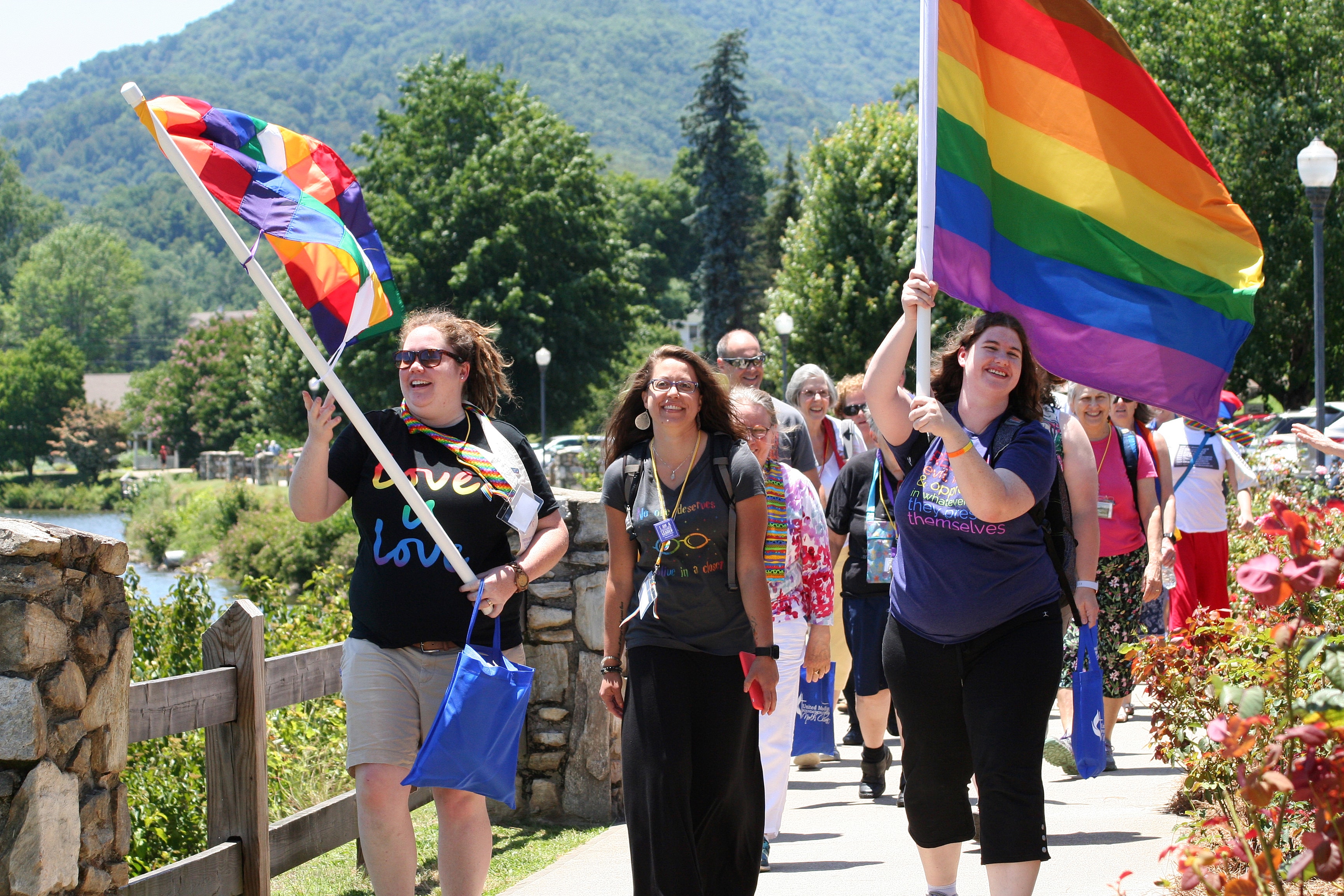
Participants walk in a Reconciling Ministries Pride March during the 2019 Western North Carolina Annual Conference held at Lake Junaluska. Photo by Neill Caldwell, Western North Carolina Conference.
The North Carolina conference approved a task force to study pastoral care for LGBTQ people. The Rev. Laurie Hays Coffman proposed the task force citing rising gay teen suicide rates, increasing murder rate for transgender people and many requests from clergy and lay people asking for guidance on how to care for LGBTQ people. The task force will meet over the next year and report back to the 2020 North Carolina Conference.
The Michigan Conference supported the creation of a central conference in North America. Pacific Northwest also called for the formation of the United States as a central conference. Central conferences, the regional church bodies in Africa, Europe and the Philippines, can adapt parts of The Book of Discipline, the church’s lawbook, for their specific missional context.
Minnesota delegates voted to adopt a vision that commits to the full inclusion of LGBTQ people.
Mountain Sky, Desert Southwest, Upper New York all formed teams to explore options to move forward. Western Pennsylvania called for the Connectional Table to create a task force to prepare a process for dividing the denomination. New England approved commissioning the Open Spirit Task Force to examine how United Methodists might create a new church body.
California-Nevada recommended creation of a structural change task force.
Alaska, Great Plains, Central Texas and Western North Carolina affirmed the four commitments that came from the UMC Next meeting held at United Methodist Church of the Resurrection May 20-22.
These include:
- To be passionate followers of Jesus Christ, committed to a Wesleyan vision of Christianity.
- To resist evil, injustice and oppression in all forms and toward all people and build a church that affirms the full participation of all ages, nations, races, classes, cultures, gender identities, sexual orientations and abilities.
- To reject the Traditional Plan approved at General Conference 2019 as inconsistent with the gospel of Jesus Christ and resist its implementation.
- To work to eliminate discriminatory language and the restrictions and penalties in the Book of Discipline regarding LGBTQ individuals.
One resolution came before the Missouri Conference to provide $30,000 from which congregations can submit grant applications to assist ministries for the LGBTQ community or to lift up persons from that community into missional leadership. According to the Book of Discipline, the church is still called to be in ministry to the LGBTQ community. Funds from the Missouri resolution would go toward fulfilling that mandate.
Alaska, one of the denomination’s missionary conferences, discussed the next expression of Alaska Methodism. Two alternatives were presented — become a mission district of another conference or withdraw from the denomination.
Four of the seven conferences in the Western Jurisdiction — Oregon-Idaho, California-Pacific, Desert Southwest and California-Nevada — voted to petition the jurisdiction’s College of Bishops to convene a special conference to consider separating from the denomination.
Meeting after the close of the California-Nevada conference, Bishop Minerva Carcaño and her cabinet met and released a statement that said, in part, that disaffiliation “would not fulfill the promise of the Wesleyan spirit and Methodist ethos, or the calling to leadership as a jurisdiction.”
LGBTQ people were commissioned, ordained or licensed in the California-Nevada, Baltimore-Washington, Michigan, New York, Northern Illinois, Oregon-Idaho, Desert Southwest, Mountain Sky and North Texas conferences. North Texas Bishop Michael McKee said the openly gay pastor ordained in his conference is single and does not violate the Book of Discipline.
Conferences that rejected the Traditional Plan included:
- Oregon-Idaho
- Pacific Northwest
- Northern Illinois
- Great Plains
- California-Pacific
- Desert Southwest
- Upper New York
- Minnesota
- California-Nevada
- Iowa
- Wisconsin
- North Carolina
Conferences calling for removal of incompatibility language from the Book of Discipline:
- Virginia
- Indiana
- North Carolina
- California-Pacific
- New York
- Dakotas
- Upper New York
- California-Nevada
Among the conferences that stood by the action of the 2019 General Conference was Holston.
The Holston Conference approved a ‘commitment’ resolution that fell short of disagreeing with the Traditional Plan. It resolved to “join hands as one, united through our prayers, our gifts, our service and our witness as we work together toward God’s hope for the people of Holston and grieve for the harm caused to the body of Christ and its witness in the world.”
Indiana left in the language “homosexuality is incompatible with Christian teaching” but added language calling for strict global enforcement of laws prohibiting the sexual exploitation of children and for adequate protection, guidance and counseling for abused children. Another amendment to the petition added, “The Church should support the family in providing age-appropriate education regarding sexuality to children, youth and adults.”
Story based on conference reports
This story is based on information from the 44 U.S. annual conference reports provided to UM News. UM News posts annual conference reports from the U.S., Africa, Europe and the Philippines at their website. UM News will continue posting reports as provided.
A petition to remove the current qualifications for ordination failed to pass the Indiana Conference.
In East Ohio, two resolutions to realign the church to allow both traditional and progressive understandings of LGBTQ clergy and same-gender weddings and to adopt the four tenets developed by UMC Next were defeated.
The Kentucky Conference concluded with an “emotional and sometimes painful” debate over whether to remove the incompatibility language, said Alan Wild, ministry assistant to the director of new church development for the conference. The effort was voted down 458-283.
The Rev. George Strunk one of the sponsors of the resolution, struggled with composure during the debate, his voice breaking at times.
“Being Methodist has never felt so difficult as it does today,” Strunk said.
The Rev. Bill Arnold, one of those who spoke against the measures, said that approving the petition would be “a major break with Christian tradition.” The church must not become a window into the larger culture, he said.
At one point, Bishop Leonard Fairley admonished the delegates not to clap. “No applause. We are going to do this in the spirit of Christ. This is not about winners and losers.”
Like what you're reading? Support the ministry of UM News! Your support ensures the latest denominational news, dynamic stories and informative articles will continue to connect our global community. Make a tax-deductible donation at ResourceUMC.org/GiveUMCom.


