
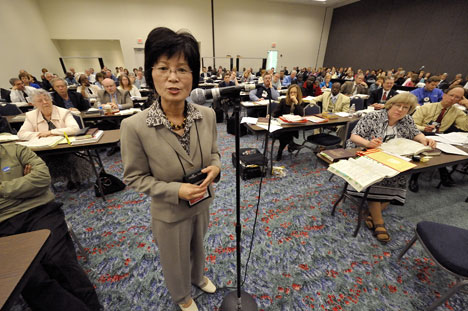
When the 2008 General Conference was over, I headed to the Dallas-Fort Worth airport with my eyes barely open.
As I checked my luggage, a couple of delegates standing next to me asked, "So, what is the order of the day?" We laughed. On the plane to Denver, another group of United Methodists asked, "What calendar items are you going to present?"
We were all happy there were none left to deliberate!
As chairperson of the Committee on Agenda and Calendar, ordering the agenda and calendar was my responsibility during 10 days of the General Conference, in consultation with the coordinator of the calendar and the entire committee. This was my fourth General Conference as a delegate, but it was the first time that I served on the Agenda Committee. My learning curve the first few days was steep. However, it was a privilege to serve in this capacity, and I learned how complex the work of scheduling legislative calendar items can be.
Time management
The underlying issue we faced was a basic daily scheduling structure. Delegates felt pressured with each day's tight schedule, which began at 8 a.m. and ended at around 11 p.m., with two less days to work than at previous General Conference meetings.
With less time for legislative committee work, many committees had to work through lunch and dinner breaks and after plenary sessions during the second week. For example, one committee completed its work only on Wednesday of the second weektwo days before the conference adjourned. From the point of view of the Agenda Committee, it was difficult to order consent calendar and calendar items since several legislative committees still were completing their work.
"What we are doing at the General Conference is a spiritual work. Jesus told us to take Sabbath."
Some who felt we had significantly less time for both committee and plenary work proposed that no less than 75 percent of General Conference be dedicated to legislative work. For me, the issue was not a lack of scheduled time for legislative work, but that many plenary presentations including worship ran over their scheduled time. In fact, 74 percent of this General Conference was scheduled for legislative work. My suggestion for the 2012 General Conference is to strongly urge that each presenter keep his or her presentation to the assigned time.
In spite of a pressured schedule, we completed all the calendar items through various creative omnibus motions made by delegates. As usual, the delegates were committed to completing their work.
Sunday off
Another scheduling challenge was not taking a day of rest on Sunday, as we have in previous assemblies, in an attempt to save conference expenses. With lack of sleep and a tight schedule, delegates were getting sick by the beginning of the second week. Some said, "I feel as if my eyes don't belong to me," indicating their eyes were red and puffy from sleep deprivation.
Such concerns led the Committee on Agenda and Calendar to move that no order of the day be scheduled on Sunday during the 2012 General Conference. I suggested we take Sunday off as a day of rest and provide time to attend local worship services in Tampa, Fla., where the next General Conference will be held. I believe that suggestion received the biggest applause from the delegates. The motion passed with an astounding yes!
So, we will have Sunday as a day of rest and a day of worship during the 2012 General Conference! What we are doing at the General Conference is a spiritual work. Jesus told us to take Sabbath. As we are called to make disciples of Jesus Christ for the transformation of the world, our spirit is strengthened and nurtured through an appropriate time of rest and Sabbath.
See you in 2012!
*Kang is superintendent of the Metropolitan District in the United Methodist Rocky Mountain Annual (regional) Conference.
News media contact: Marta Aldrich, Nashville, Tenn., 615)-742-5470 or newsdesk@umcom.org.
Related Articles
Commentary: Deliberating under the influence (of too little sleep) at GC 2008
Resource
Like what you're reading? Support the ministry of UM News! Your support ensures the latest denominational news, dynamic stories and informative articles will continue to connect our global community. Make a tax-deductible donation at ResourceUMC.org/GiveUMCom.


