
The effort to create a new United Methodist structure for U.S. decision-making received a boost from bishops in Africa, Europe and the Philippines.
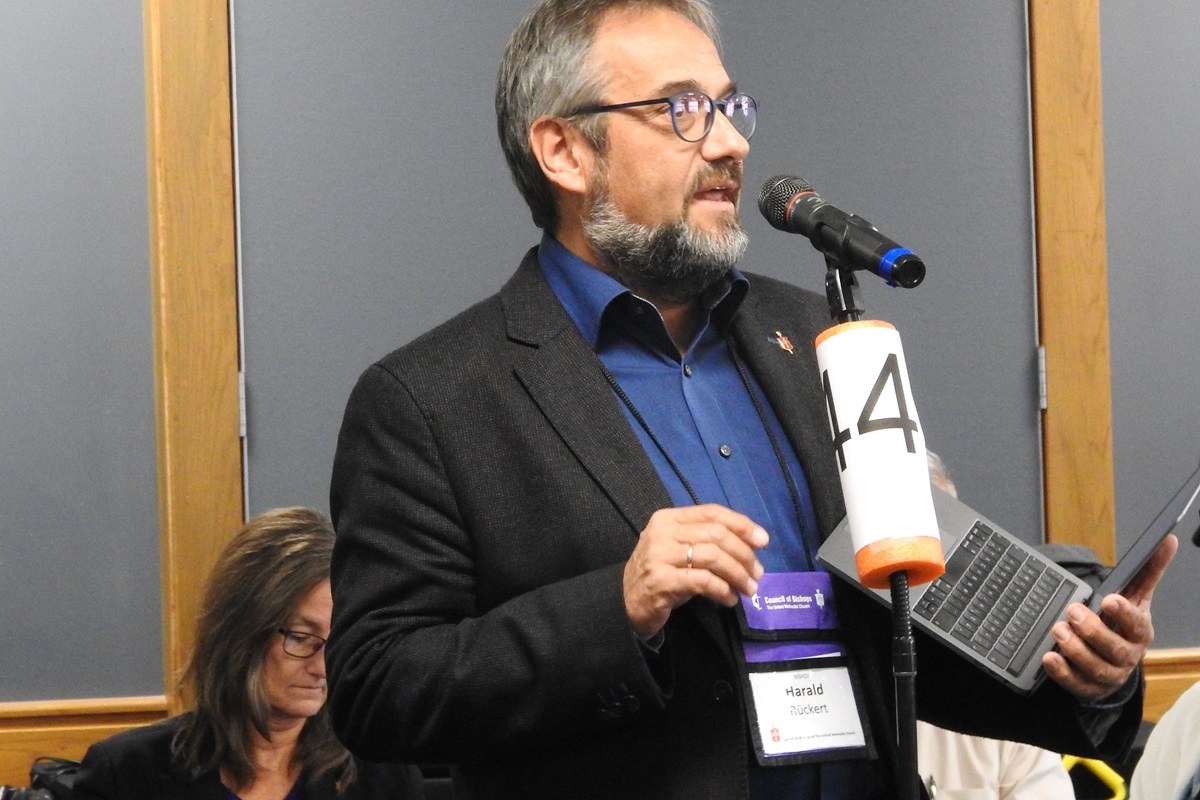
“The central conference bishops will promote and solidly support the U.S. regional conference proposal,” Bishop Harald Rückert of Germany announced to applause near the end of the fall Council of Bishops meeting.
Rückert was reading a statement he said the Central Conference College of Bishops unanimously passed during its meeting Nov. 1 after hearing a presentation on the proposal.
The Connectional Table, a multinational body that acts as a sort of church council for the denomination, drafted the proposal. The group’s goal is to have a body to take up matters that solely affect the U.S. church and ease the burden on the multinational General Conference. U.S. proposals often dominate The United Methodist Church’s top lawmaking assembly.
While the Connectional Table doesn’t see the proposal as addressing the denomination’s homosexuality debate, other United Methodists see it as a way of allowing the church in the U.S. to make changes to allow same-sex marriage and ordination of “self-avowed practicing” gay clergy.
Wespath, the denomination’s pensions agency, collaborated on the legislation to help vet any legal or administrative issues. The proposed regional conference would encompass the United States and maintain the current five U.S. jurisdictions.
“I believe this proposal will enable us to live more fully as a worldwide church,” said Bishop Christian Alsted, Connectional Table chair, in a statement after the bishops’ meeting. “It will give the church in the U.S. a structure to deal with its unique missional challenges and to do its visionary, strategic and administrative work.”
Ultimately, General Conference delegates will have their say when the assembly convenes May 5-15, 2020 in Minneapolis.
The central conference bishops’ endorsement is a big deal for an idea that previously has faced strong opposition. As recently as 2016, petitions to create a U.S. central conference and other proposed new regional structures didn’t make it out of committee at General Conference.
Bishops don’t have a vote at General Conference, but they have influence in other ways. When bishops speak, United Methodists frequently listen.
The Council of Bishops in May affirmed the Connectional Table’s work on the structure. The central conference bishops went a step further — asking their steering committee to invite representatives from the Connectional Table to present the proposal to General Conference delegates in Africa, Europe and the Philippines. United Methodist protocol dictates that church leaders only visit an area at the resident bishop’s invitation.
Immediately after the Nov. 3-6 Council of Bishops meeting, UM News reached out to multiple central conference bishops to for comment on the proposal. Only three responded, including Alsted.
“The makeup of The United Methodist Church has changed significantly over the past 20 years and soon half of its membership will be in Africa,” Alsted told UM News. “For the General Conference to become a meaningful global gathering that will help the church pursue God’s mission, it needs to be reshaped.”
For more than 200 years, The United Methodist Church and its predecessors have operated with assumption of United States as a default.
The denomination’s constitution authorizes central conferences to make “such changes and adaptations” to the Book of Discipline as missional needs and differing legal contexts require.
In practice, that means central conferences make decisions related to administering their own clergy pensions, their own church property and in some cases, their own clergy’s educational requirements.
Alsted said central conference bishops wish to extend that privilege to the entire church.
Since 2012, the denomination’s Standing Committee on Central Conference Matters has been working to determine which parts of the current Book of Discipline’s Part VI are essential for all United Methodists and which can be adapted. Part VI, the largest section in the Discipline, deals with organizational and administrative matters.
The Connectional Table began working on its proposal to have a place where the U.S. can do its adaptive work. It also has worked closely with the standing committee throughout the process.
Alsted stressed that the Connectional Table’s work should be seen alongside what the standing committee has been doing and not as a way to solve the denomination’s current impasse over homosexuality.
The Connectional Table proposal
- Stage I would form a committee of the General Conference, with legislative function, to deal with U.S. matters — adaptable disciplinary provisions, U.S.-related resolutions and non-disciplinary petitions concerning the U.S.
- Stage II would form the U.S. regional conference, and the Stage I committee would end its work.
Creating a new legislative committee on U.S. matters would only require a simple majority vote at the 2020 General Conference.
However, creating the regional conference requires multiple constitutional amendments. For ratification, amendments must receive at least a two-thirds vote at General Conference and at least two-thirds of the total votes at annual conferences.
That hasn’t stopped other United Methodists from seeing the Connectional Table’s proposal as a way to maintain connection despite church divisions.
Bishop Rodolfo A. “Rudy” Juan, who leads the Davao Area in the Philippines, urged fellow central conference bishops to support the Connectional Table legislation.
He said the benefits of the Connectional Table proposal include a certain level of autonomy “because we can be self-governing, self-propagating and self-sufficient.”
This summer, he and others in the Philippines College of Bishops specifically recommended restructuring that would allow for regional autonomy to deal with divisive issues like homosexuality.
A group of Filipino United Methodists has submitted legislation to General Conference in support of the bishops’ resolution and the Connectional Table’s proposal. That legislation also calls on the Connectional Table and Standing Committee on Central Conference Matters to develop a new form of church organization that allows for different cultural contexts.
Sierra Leone Area Bishop John K. Yambasu, president of the Central Conference College of Bishops, has been leading negotiations about the future of the church.
However, he said, he would like to see regional conferences for each of the denomination’s four continents to deal with issues that pertain to those continents.
Yambasu said homosexuality is a hot button issue in the U.S., not in Africa. “There are particular issues that have nothing to do with Africa,” he said.
Yambasu added that the whole concept of central conferences has a historical stigma to it because of the similarity of the name to the Central Jurisdiction, which segregated African-American Methodists in the United States.
“I’d rather we just be a regional conference,” he said.
Hahn is a multimedia news reporter for United Methodist News. Contact her at (615) 742-5470 or newsdesk@umcom.org. Gladys P. Mangiduyos, communicator in the Philippines, contributed to this story. To read more United Methodist news, subscribe to the free Daily or Weekly Digests.Like what you're reading? Support the ministry of UM News! Your support ensures the latest denominational news, dynamic stories and informative articles will continue to connect our global community. Make a tax-deductible donation at ResourceUMC.org/GiveUMCom.


