
United Methodist Africa University has managed to survive the economic challenges facing the country by cutting back, adapting to the changing fiscal environment and remaining in good standing with suppliers of goods and services.
The prices for fuel, basic supplies and services in Zimbabwe are rising every week and some products are difficult to find. Electricity is unavailable at times for up to 18 hours a day, resulting in the nation resorting to alternative sources of power, such as solar systems and petrol or diesel generators.
“The principle that we use is, we prune and grow,” said Africa University vice chancellor Munashe Furusa. “We recognize there are areas we can do without for this year, and we cut down on those areas.
“As administrative staff, we also teach and thereby reduce labor costs. Anything that we can do to save money, we do,” Furusa said.
“Part of it is to understand what is core and to agree as a principle that we can forego certain things this year and then pick them up the following year.”
Furusa said, at times, the prices of goods were rising daily.
“To cope with these price hikes, we are buying in bulk. Sometimes, we buy from outside the country where possible and make sure we keep our stocks,” he said.
Related: United Methodists adapt to economic turmoil
Many in the church, including pastors, are turning to entrepreneurship as the job market worsens and prices skyrocket. Chenayi Kumuterera reports.
The university has a standby generator that provides power during electricity outages. “The cost of running the generator is very high. That’s one of our major cost drivers,” Furusa said.
Stephene Chikozho, AU director of advancement and public affairs, said the university is working to install a solar plant to provide off-the-grid energy for the whole campus within the next 12 months.
Furusa said that sometimes the university consults the students on how to adapt to the economic challenges.
“We talk to our students and we increase prices where possible,” he said. “We have shared the governance, responsibility and accountability with the students.”
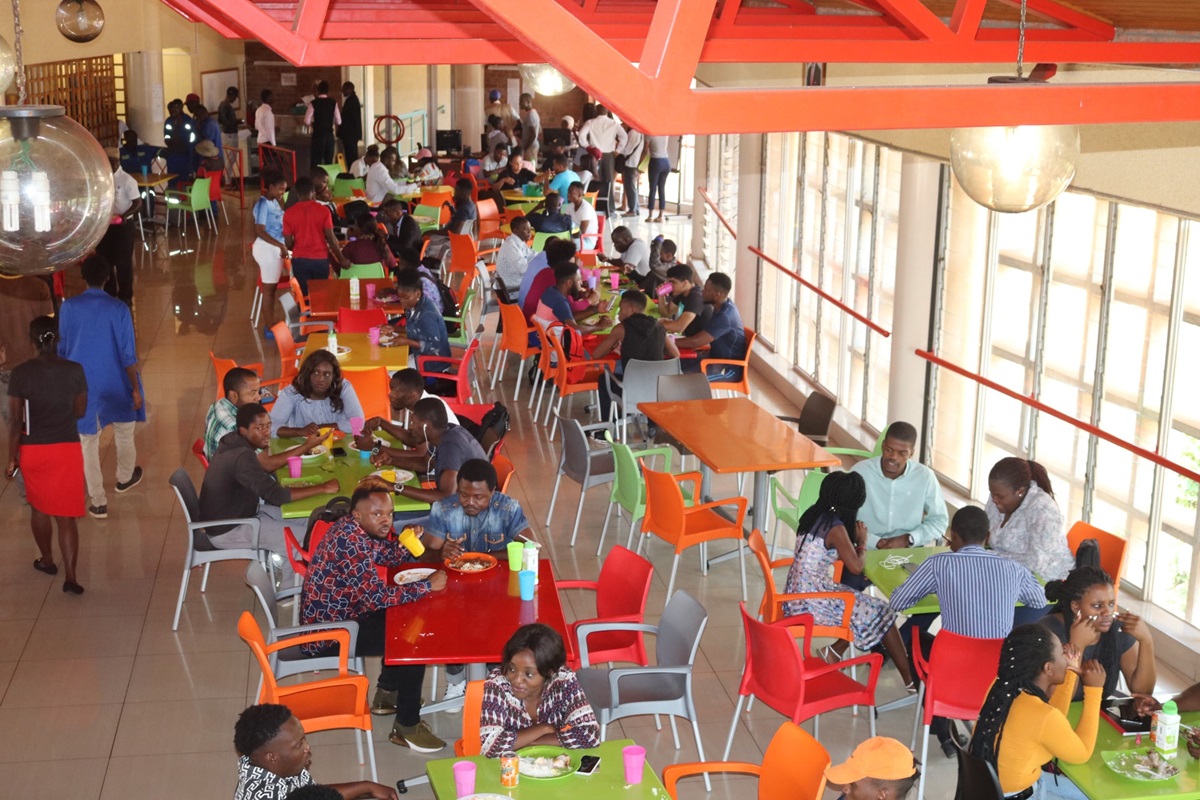
The university’s food services manager, Sarah Dube, said her department always stocks in advance and when inventory is down to one month’s supply, they restock. This has cushioned the department, which serves about 1,200 people during lunch and dinner, from the rising prices and unavailability of some foodstuffs.
“We have good relationships and rapport with our partners and suppliers. We have a good track record for paying and have built a good name for ourselves, so by the grace of God, everything we require in the dining hall is available,” Dube said.
The Food Services Committee, made up of students and staff who deliberate on prices, sets the cost of meals.
“We are managing the portions we serve so that everyone can afford (to eat). Those who require more can pay for extras,” she said.
In addition to offering standard meals, the Africa University dining hall caters to those on low-fat or low-sugar diets. The Africa University Farm provides most of the vegetables, pork and poultry.
Fiston Okito, a final-year divinity student from Congo and vice president of the Students Representative Council, said the increase in fees at the institution has mainly affected the Zimbabwean students, because international students pay their fees in foreign currency, which has not changed.
“The increase in fees has affected the Zimbabwean students because of the exchange rate, but all students have been affected by the rise in costs of meals, which have gone up about three times since the beginning of the year,” Okito said.
“In the dining hall, the food portions have decreased. In the past, students would complain and ask for more sadza (a Zimbabwean staple food made of corn), but instead of increasing, the portions have grown smaller,” he said.
Okito said power cuts affect students, especially when it’s cold.
“There is no way to produce hot bath water and students sometimes come late for lectures,” he said. “We used to study during the night, but this is not always possible as the generator may switch off, leaving us in darkness.”
Students staying off campus have a challenge when it comes to attending lectures due to high fuel prices that have pushed up bus fares.
Subscribe to our
e-newsletter
Nyumbazi Ngwata, a third-year business management student from Malawi, stays off campus because she could not find accommodation in the AU halls of residence, which were at capacity. The university accommodates 962 students in its hostels and has facilitated accommodation of many students in Mutare. A new hostel is currently under construction with gifts from Highland Park United Methodist Church in Dallas.
“Living in Mutare town and commuting to classes is a major challenge at the moment,” Ngwata said. “The college buses are not enough and private transport is very expensive — between $8 to $12 one way. Sometimes, we have to stand all the way from town as the bus will be full.”
Ngwata also lamented the change in food prices and quantities at the dining hall.
“During my first year at the university, the food portions were generous and the prices were fair,” she said.
Africa University has a student enrollment of over 2,500, from 25 African countries, compared to 1,856 in September of 2018, Furusa said. About 54 percent of the students are female, while 20 percent are international students.
“Student enrollment has increased due to the rollout of new programs such as online degrees, where three programs are currently being offered,” he said.
Furusa said the university keeps growing because of its Holy Spirit-guided vision, which is shared across Africa and the worldwide church.
“Our growth is also due to faith-filled commitment and action by the people called United Methodists. We also attribute our success to the steadfast investment by friends and partners, and the sacrifice and expertise of our staff and students,” he said.
Chikwanah is a communicator of the Zimbabwe East Conference.
News media contact: Vicki Brown at (615) 742-5470 or newsdesk@umnews.org. To read more United Methodist news, subscribe to the free Daily or Weekly Digests.
Like what you're reading? Support the ministry of UM News! Your support ensures the latest denominational news, dynamic stories and informative articles will continue to connect our global community. Make a tax-deductible donation at ResourceUMC.org/GiveUMCom.


