Key points:
- Retired Northern Illinois Conference elder reflects on the early experiences that drew him to Methodism.
- When deciding whether to remain in the denomination, he said, the image of the cross came to mind, with the two beams representing his relationships with God and United Methodist leaders.
- Recognizing that healing is needed within the Korean Methodist community, he said he believes “that the grace of Jesus Christ is greater than all our wounds.”
Commentaries
I was asked recently to speak on the subject of why I chose to remain in The United Methodist Church. Preparing for this message gave me an opportunity to reflect deeply on my own life. To explain why I remained, I first had to examine how I came to stand where I am today and the journey that brought me here.
When I entered college in 1954, existentialist philosophers often spoke of a profound truth. They taught that there is a supreme moment in human existence (vor Gott), and that moment comes when a person stands alone before God.
As I reflected on that idea and asked myself where Eun Chul Cho should stand, the image of the cross came to mind.
The vertical beam of the cross represents my relationship with God. The horizontal beam represents the relationships I formed with the leadership of The United Methodist Church throughout my years of ministry. Where these two beams intersect — where the vertical and horizontal meet — I found my own existence.
Let me begin with the vertical dimension.
My relationship with God was, in many ways, established before I was even aware of it.
Among the early Methodist missionaries who came to Korea were the Rev. Robert Sharp and his wife, Alice Sharp. Stationed in Gongju, they traveled tirelessly to nearby communities such as Nonsan, Ganggyeong, Buyeo and Hongseong, proclaiming the Gospel.
Through their ministry, my mother became a member of First Methodist Church in Nonsan during the early 1930s.
Those pioneer missionaries often combined evangelism with practical service. Alice Sharp was a trained midwife. When my mother gave birth to me, she came to assist with the delivery. After bathing the newborn baby, she gave me the name Eun Chul (恩鐵).
At that time, a measles epidemic was devastating our village, and many children died. My parents had already lost four children. Mrs. Sharp chose the name Eun Chul because she prayed that, by God’s grace, I would grow strong and enduring like iron.
There was another defining event in the formation of my relationship with God.
My mother died when I was 9 years old. Throughout my adolescence, I carried a deep longing for her. Because she had died of a stroke, I dreamed of becoming a physician. I wanted to attend medical school, become a doctor and help those suffering from the same illness that had taken my mother’s life.
Then, one day during my senior year of high school, my father said something that changed the course of my life.
“Your mother always hoped that one of our three sons would be dedicated to God’s service. I have prayed about it many times, and I believe you are the one. I think you should fulfill your mother’s deepest wish.”
After hearing those words, I gave up my dream of studying medicine and entered the Methodist Theological Seminary as a member of the Class of 1954.
Years later, I shared this story with Dr. Hyun Seol Hong, who was then dean of the Methodist Theological Seminary in Korea. After listening, he said, “Eun Chul, through the death of your beloved mother, God called you into His service.”
Those two experiences shaped the vertical dimension of my life from the very beginning.
Because my relationship with God was formed in this way through the Methodist Church, I could never leave it. Nor could I imagine separating myself from what is now The United Methodist Church.
Now let me turn to the horizontal line of the cross and speak about how my relationships with the bishops of The United Methodist Church were formed.
In 1972, before Garrett Theological Seminary merged with Evangelical Theological Seminary to become Garrett-Evangelical Theological Seminary, I enrolled at Evangelical Theological Seminary, where I completed my Master of Divinity degree.
After graduation, I met with Bishop Paul Washburn, who at the time served the Chicago Area. I told him, “I would like to plant a Korean church in an area where many Korean immigrants live. I ask for your approval and blessing. I also hope to be received into full membership in the Northern Illinois Conference, as I am already a full member of the Korean Methodist Church.”
Bishop Washburn smiled and replied that he had never encountered such a request before.
“As a bishop, I cannot oppose the planting of a new church, so yes, I approve your plan. However, we have no budget for it. Would you be willing to serve for one year without salary? In return, I will make sure you have the use of any church building you need in the area you have chosen. I will also help your wife find employment. After one year, we will evaluate the results and consider receiving you into full membership in the conference.”
That was what he told me.
What he did, however, was even more remarkable.
Every month, Bishop Washburn quietly arranged for $1,500 to be sent to support my ministry from the district superintendent’s discretionary fund.
I thanked God that I had become part of a church that was reasonable, inclusive, conciliatory and encouraging — the kind of church I found in The United Methodist Church.
For the next seven years, I devoted myself to ministry among Korean immigrants.
Eventually, however, I sensed that it was time to move beyond immigrant ministry and serve in the broader American community. I requested an appointment to an English-speaking congregation and was assigned to Cedarville, Illinois, a rural farming community of conservative, hardworking people, many of whom were of Pennsylvania Dutch heritage.
My wife and I were deeply satisfied with that ministry.
Then another challenge arose.
Our oldest daughter was in high school. Each day she rode the school bus from Cedarville to Freeport, where the high school was located. Whenever she boarded the bus, some of the American students would mock her by calling her “Jiang Qing.”
I tried to reassure her, saying that Jiang Qing — the wife of Mao Zedong — had an honorable-sounding Chinese name. But my explanation did little to ease her pain.
Whenever our family ate at places like McDonald’s or Pizza Hut in Freeport, children would crowd around the windows just to stare at the “Jiang Qing” inside.
My daughter became increasingly withdrawn, and her grades began to decline.
After serving there for three years, I requested a new appointment.
Although Bishop Washburn had already retired, he listened carefully as I explained the reason for my request. He then spoke with his successor, Bishop Jesse R. DeWitt, and helped arrange my transfer back to the Chicago area.
Once again, I thanked God for belonging to a church whose leaders listened to people’s needs, acknowledged their struggles, cared deeply for them and acted compassionately to help them.
Under Bishop DeWitt’s leadership, we organized a mission team to Korea.
The bishop entrusted me with planning much of the itinerary, but he gave me several specific requests that he wanted included.
He wanted the team to worship at Jeongdong Methodist Church, the birthplace of Northern Methodist mission work in Korea. He also wanted to visit the home of Kim Dae-jung, who was then under house arrest and later became president of South Korea and a Nobel Peace Prize laureate, tour an industrial mission ministry and visit the Demilitarized Zone.
A team of 50 people departed for Korea for what was planned as a week-long mission trip.
There was one additional event that I especially wanted to include in the itinerary.
I wanted the team to experience a Wednesday evening worship service at a Korean church.
I arranged for Bishop DeWitt to preach at Kwanglim Methodist Church, where Bishop Sun Do Kim served as senior pastor, and I interpreted the sermon.
After the service, Bishop Kim invited Bishop DeWitt to his office for tea.
During their conversation, Bishop Kim presented Bishop DeWitt with a white envelope.
The bishop politely declined.
Back and forth they went, each insisting.
Finally, Bishop DeWitt said, “Then please use it as an offering for the physically disabled members of your congregation.”
Afterward, Bishop Kim handed me another envelope in appreciation for interpreting.
How could I possibly accept an honorarium when the preacher himself had refused one and donated it?
So I also gave it as an offering.
When the service ended, our group boarded the bus to return to the hotel.
Exhausted, I went to the back seat, closed my eyes, and tried to rest.
A little later, in the darkened bus, Bishop DeWitt slowly made his way to where I was sitting. Leaning close so that only I could hear, he whispered, “Why didn’t you accept the honorarium? You worked as the interpreter. I feel sorry because I think you refused it because of me.”
Subscribe to our
e-newsletter
I have never forgotten those words.
They reflected the openness, honesty, humility and compassion of a true Christian leader.
And once again, I thanked God for allowing me to belong to The United Methodist Church, a church blessed with such leaders.
There is one more person who has profoundly influenced my understanding of why I remain in The United Methodist Church: the Rev. Chang Jun Kim.
In Korea, Rev. Kim has often been regarded as a controversial figure. Yet I have long been fascinated by his life and ministry, and I have devoted years to studying him. In fact, I am currently writing a scholarly work about him.
What drew me to him?
He was, above all, a patriot.
As the Methodist representative among the 33 signatories of the March First Declaration of Independence, he willingly endured six years in prison for the sake of his country.
Yet even while pursuing his patriotic calling, he never abandoned the Methodist Church. Neither did he divide the denomination in order to advance his own progressive ideas or theological convictions.
That example has stayed with me throughout my ministry.
Looking back on my life, I see the cross once again.
Vertically, I encountered the grace of God through the Methodist Church.
Horizontally, through my relationships with the leaders of the denomination, I experienced the openness, honesty, compassion and pastoral care that have characterized The United Methodist Church at its best.
Through those relationships, I learned what love is.
Through those relationships, I received love.
How, then, could I ever leave such a church?
I have continued to pray for healing within the Korean Methodist community.
I know that we have all experienced pain and carried disappointments. Some of us have been deeply wounded by conflict, while others have been discouraged by division.
Yet I believe that the grace of Jesus Christ is greater than all our wounds.
It is my prayer that, through the grace of our Lord Jesus Christ, this gathering may become a place where old wounds are healed, broken relationships are restored and we find the courage to begin again together.
May God’s grace bind us together once more.
May Christ’s love guide our steps.
And may the Holy Spirit lead us into a new future of hope, unity and faithful service.
Amen.
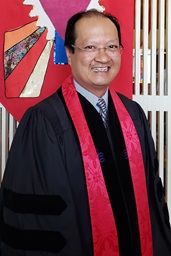
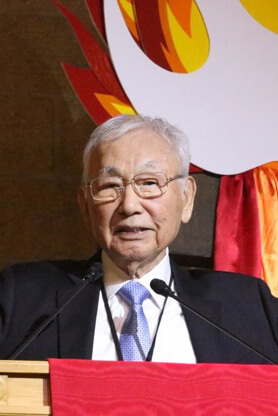
Rev. Cho served several congregations in the Northern Illinois Conference, including First Korean United Methodist Church, and was the eighth president of the Association of Korean United Methodist Churches. He retired in 2000.