
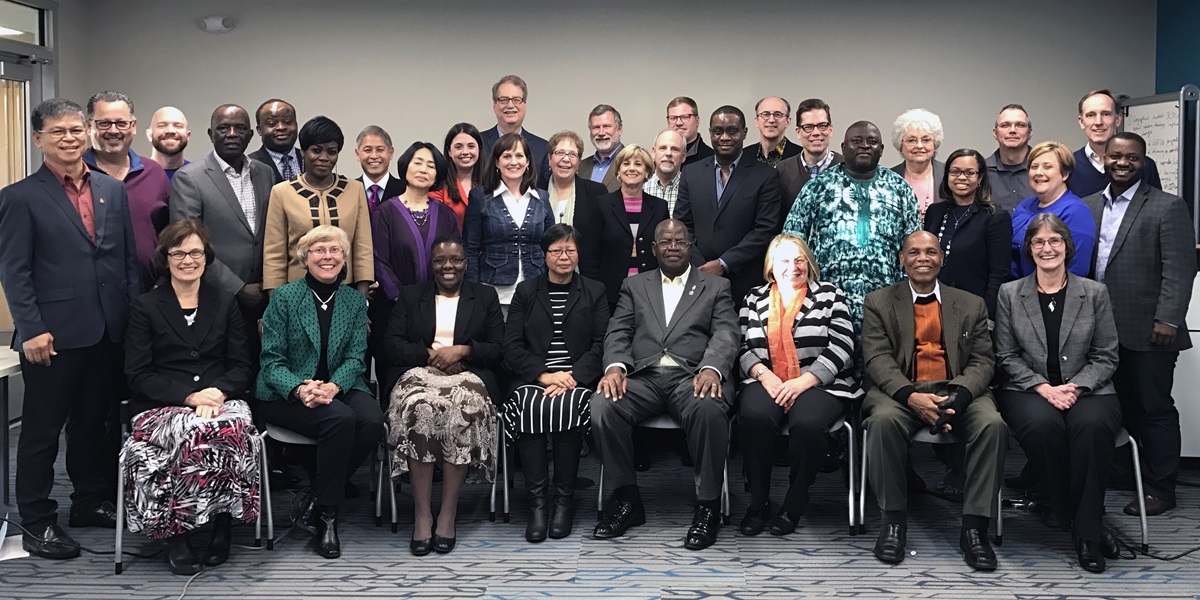
The Commission on a Way Forward is sketching plans for moving The United Methodist Church beyond its impasse around homosexuality.
At this point, commission members are not saying what those plans look like. Instead, the commission is waiting to unveil its proposals until it gets preliminary approval from the Council of Bishops in November.
“The outlines of plans or conceptual models are still in development, and since we are a commission of the Council of Bishops, it is appropriate that we speak with them first,” said Florida Area Bishop Kenneth H. Carter Jr., one of three moderators of the 32-member, multinational commission.
As with its previous meetings, the commission’s fourth gathering on July 19-21 was closed to all but invited guests. Members of Love Prevails, which advocates for full inclusion of LGBTQ individuals in church life, tried to attend but were barred from the meeting space.
The meeting took place at Wespath Benefits and Investments in the Chicago suburb of Glenview, Illinois. However, before the meeting, the commission moderators refused to tell United Methodist News Service where the meeting would be held, citing “reasons that range from security to confidentiality of the materials discussed.”
General Conference, the top legislative body of the church, authorized the bishops in a 428 to 405 vote to form the commission, after rumors of a potential denominational split reached a fever pitch during the 2016 assembly. The commission has the task of trying to find new ways to embody unity amid differing views of the status of LGBTQ individuals in church life.
The commission’s membership includes nine bishops, 11 laity, 10 elders and two deacons. Alongside Carter, the other moderators are West Virginia Area Bishop Sandra Steiner Ball and retired Bishop David Yemba of the Democratic Republic of Congo.
Learn More AboUt Way Forward
To see moderators’ commentaries and commission press releases, visit www.umc.org/wayforward.
At its previous meeting in April, commission members said they were looking at ways to loosen the church connection.
The Rev. Thomas Lambrecht, one of the commission members, said the commission is still moving in that direction.
“We are trying for something that has broad support from people across the spectrum,” Lambrecht said. “At this point, we’re hopeful of getting that.”
Lambrecht is a leader in the Wesleyan Covenant Association and Good News, both groups that advocate for retaining the denomination’s bans on same-gender marriage and the ordination of “self-avowed practicing” gay clergy. Both groups also have raised the possibility of a church split.
“We are trying for enough differentiation that will allow freedom of conscience and as much unity as possible within that,” Lambrecht said of the commission.
Carter said that the commission has completed less than half of its planned meetings before April 2018.
Not making its work public at this point “is not about concealment,” he added, “but about the patient and respectful work done by a diverse, global and multilingual body in responding to a matter whose complexity has led to the present impasse in the church.”
Days after the meeting, the commission released a status report.
Lambrecht described the status report as a slideshow that shows "the kind of things that are core to our church’s identity and practice.”
He said the slideshow also shows the commission’s principles in evaluating proposals as well as some of the input it has received.
Before the meeting, the commission solicited feedback from a number of groups, including youth, young adults, seminary students, general agency executives, advocacy groups, large-church pastors and the Council of Bishops.
David Field, a commission member from Switzerland, said the proposals from these various United Methodists “were diverse and even contradictory.”
“We are careful not to align ourselves with any particular group but rather to seek to hear from all,” he said. “What is important for us is to develop a comprehensive plan that addresses the concerns that lie behind these various proposals.”
At this most recent meeting, he said, the commission paid particular attention to the diverse interests and views of United Methodists in central conferences — church regions in Africa, Europe and the Philippines.
In most African countries, same-sex activity is illegal. In much of western Europe as well as the United States, same-sex marriage is legally recognized. Russia bans anything authorities deem gay propaganda. In the Philippines, opposition to same-gender marriage remains strong, and earlier this year, President Rodrigo Duterte reversed a campaign pledge to allow same-gender unions.
“It was important to recognize that the different central conferences had different perspectives, and in some cases within a particular central conference, people held different views on LGBTQ inclusion and affirmation as well as possible futures of The United Methodist Church,” Field said. “The idea of developing the structures to allow for greater contextual relevance is still part of our thinking.”
For now, a small group of commission members is hammering out plan details before the commission’s next meeting in September.
The commission expects to put together its final recommendations in April of next year for the Council of Bishops. The bishops will then put together a report based on the commission’s proposals. The bishops have called a special General Conference to take up that report on Feb. 23-26, 2019, in St. Louis.
Hahn is a multimedia news reporter for United Methodist News Service. Contact her at (615) 742-5470 or newsdesk@umcom.org. To read more United Methodist news, subscribe to the free Daily or Weekly Digests.
Like what you're reading? Support the ministry of UM News! Your support ensures the latest denominational news, dynamic stories and informative articles will continue to connect our global community. Make a tax-deductible donation at ResourceUMC.org/GiveUMCom.


