
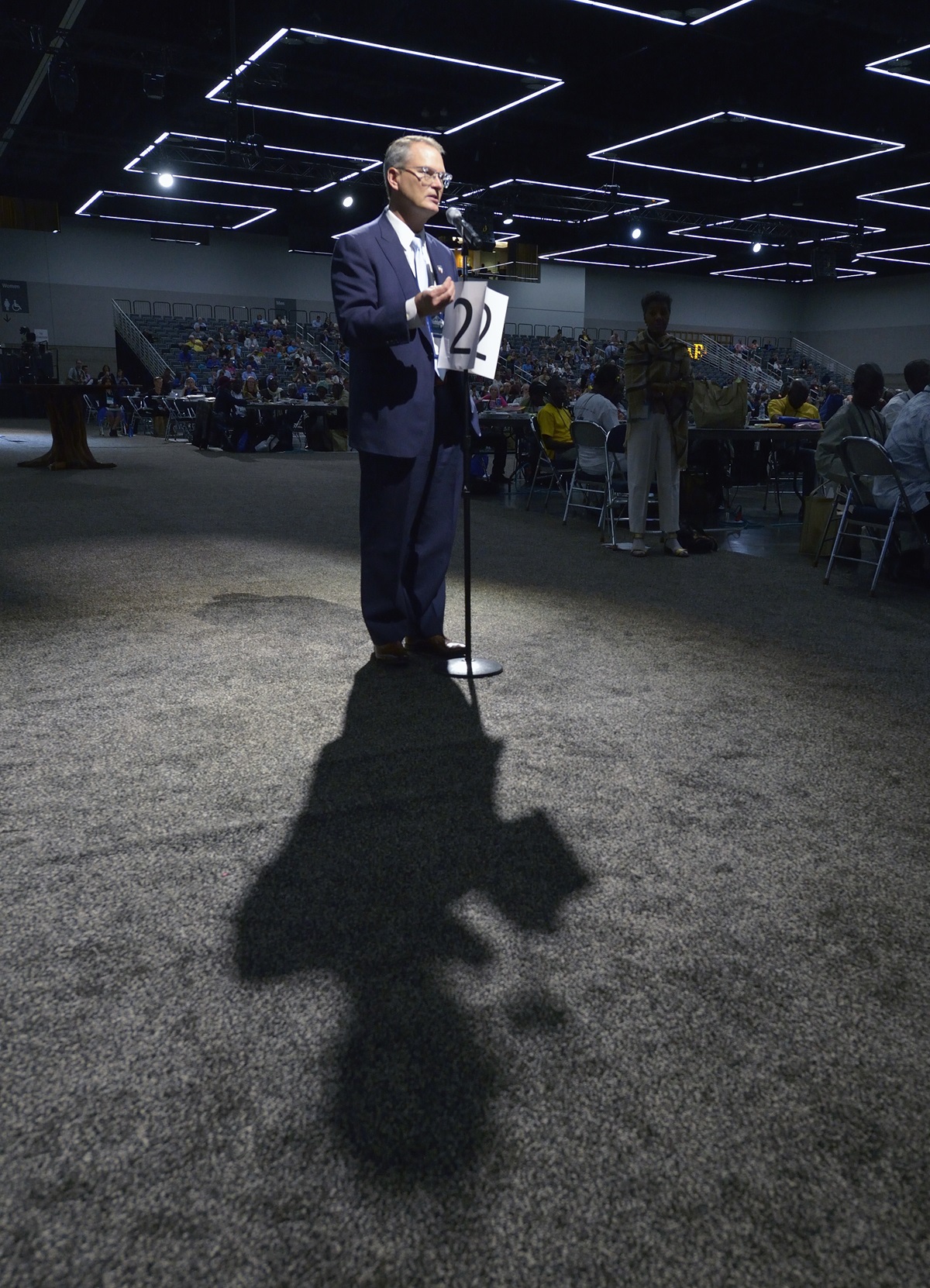
Disagreements about same-sex marriage and the ordination of LGBTQ clergy need not end in denominational divorce.
That’s the message of a new group called the Uniting Methodists Movement.
The group seeks changes to church policies so that clergy are allowed but not compelled to officiate at same-gender weddings, and so that conferences are allowed but not required to ordain LGBTQ clergy. The Book of Discipline, the denomination’s governing document, lists both the blessing of same-gender unions and being a “self-avowed practicing” gay clergy member as violations of church law.
The group already is getting pushback from both LGBTQ and traditionalist church members. However, leaders of Uniting Methodists say they are giving voice to a little-heard portion of the denomination — congregations and church members who do not see differences around homosexuality as church dividing.
Within the first 24 hours after its website went live Sept. 11, about 1,800 church members signed up to join. As of Sept. 20, more than 3,200 had joined.
“In conversations throughout the church, my experiences is that most people are somewhere between these two poles,” said the Rev. Adam Hamilton, senior pastor of United Methodist Church of the Resurrection in Leawood, Kansas, and a member of the Uniting Methodists Movement’s leadership team. Hamilton previously has championed a proposal to let local churches decide whether to host same-sex unions and welcome gay clergy.
Hamilton said he has spoken with conservatives and progressives who understand that others may have a different interpretation of Scripture and will accept more flexibility in practice. In addition, he said, there are United Methodists who are still trying to sort out where they stand.
The Uniting Methodists Movement, he said, “is vocalizing this willingness to stay together while making greater room for differing convictions on the permissibility of same-sex marriage.”
Hamilton will host an introductory luncheon about the new group Sept. 29 at the end of the Church of the Resurrection’s Leadership Institute. Uniting Methodists will have a larger Uniting Conference Nov. 13-14 at Impact Church, a United Methodist congregation near Atlanta.
The Rev. Jim Harnish, a writer, retired pastor and another group leader, said the Impact Church event would include worship, a panel discussion and workshops to equip leaders. Harnish was among a group of 47 church leaders who met in May to begin planning for what is now the Uniting Methodists Movement.
“All of the people I know in this movement are orthodox in theology, Wesleyan in spirit and tradition, and passionately committed to the mission of The United Methodist Church,” Harnish said. “Because we genuinely want to model Wesley’s 'catholic spirit,' we have never specifically asked people to name where they stand on the sexuality issues.”
Harnish said the Uniting Conference also would include a presentation by the United Methodist theologian David Field, author of “Bid Our Jarring Conflicts Cease.”
Field, a South African native, is the academic coordinator for the Methodist e-Academy based in Switzerland. He is also a member of the Commission on a Way Forward, the bishop-appointed group charged with recommending to a special General Conference ways to move The United Methodist Church beyond its impasse on homosexuality. Hamilton, who is not a Way Forward member, was one of the main champions of the commission’s formation.
Two commission members are on the Uniting Methodists Movement leadership team. They are the Rev. Tom Berlin, lead pastor of Floris United Methodist Church in Herndon, Virginia, and Dave Nuckols, Minnesota Conference co-lay leader and treasurer of the Connectional Table, a denominational leadership body. Nuckols also is on the board of Reconciling Ministries Network, an advocacy group that seeks the full inclusion of LGBTQ individuals in all aspects of church life.
Nonetheless, Reconciling Ministries Network is among the groups expressing “great concern” about the Uniting Methodists Movement’s proposals. The United Methodist Queer Clergy Caucus said in a statement that the movement’s path “threatens to fragment the grace-filled alliance between LGBTQIA+ persons and our allies by trading inclusion away for the sake of unity.”
The Rev. Will Green, pastor of Ballard Vale United Church in Andover, Massachusetts, took to social media to raise alarms about the group.
“I think it’s an attempt to create space for people to do harm and to accept that as a necessary part of who we are United Methodists,” Green, who is openly gay, told United Methodist News Service.
The new group is also facing criticism from traditionalist leaders in the denomination. Good News, an advocacy group that seeks to maintain current church rules on homosexuality, called the Uniting Methodist proposals “an exotic approach that is almost certainly a recipe for disaster.”
The Rev. Bob Phillips, a retired pastor and head of Illinois Great Rivers Conference chapter of the Wesleyan Covenant Association, wrote a blog raising “Six Questions for the Uniting Methodist Movement.” Like Good News, he also said he does not think the Uniting Methodists’ proposals can pass the special General Conference in 2019 that will take up proposals related to the church and homosexuality.
The Wesleyan Covenant Association already has urged the Way Forward commission “to propose a plan that calls for accountability” to church rules on sexuality or prepare for a denominational split. It also told the commission that any form of the “local option” such as what the Uniting Methodists Movement has proposed would be unacceptable.
To put in perspective the challenge before the Commission on a Way Forward, its 32 members includes two leaders of the Uniting Methodists Movement; a signer of the Queer Clergy Caucus statement, the Rev. Brian Adkins; and two leaders of Wesleyan Covenant Association, the Revs. Jessica LaGrone and Thomas Lambrecht. The commission is meeting Sept. 18-20 in Berlin.
The Methodist Church has split before. In 1844, the predecessor of The United Methodist Church broke apart over slavery — 16 years before the start of the U.S. Civil War.
Mike McCurry, a Uniting Methodists Movement leader, former White House press secretary and professor at United Methodist Wesley Theological Seminary, said he sees a parallel between the polarization in the denomination today and in U.S. politics.
“Dealing carefully and genuinely with the divisions about homosexuality within our own polity in The United Methodist Church can help demonstrate that we can wrestle with and transcend difficult issues that divide all Americans, the church and also non-church folks,” he told UMNS.
The Rev. Melissa Drake, another Uniting Methodists Movement leader and field outreach minister in the Iowa Conference, said she believes the criticism from multiple sides can be valuable. In fact, she sees the denomination as stronger together and a diversity of voices as a gift.
“I am heartbroken when I think about what it would be like to not be in ministry with my colleagues who challenge me,” she said.
Hahn is a multimedia news reporter for United Methodist News Service. Contact her at (615) 742-5470 or newsdesk@umcom.org. To read more United Methodist news, subscribe to the free Daily or Weekly Digests.
Like what you're reading? Support the ministry of UM News! Your support ensures the latest denominational news, dynamic stories and informative articles will continue to connect our global community. Make a tax-deductible donation at ResourceUMC.org/GiveUMCom.


