
Key points:
- Five worship services this year in Mississippi are aimed at confronting racism. The events feature music, preaching and panel discussions.
- The second of the events was held March 2 at Rust College in Holly Springs, Mississippi.
- The last 2024 Freedom Trail service will be held June 15 at Gulfside Assembly in Waveland, Mississippi.
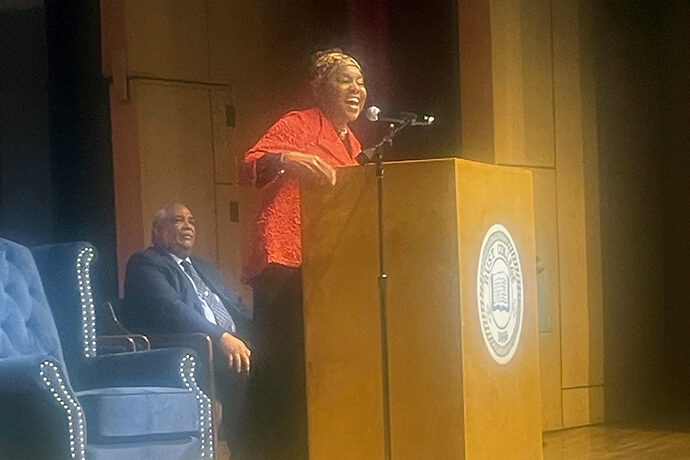
Part fiery church service, part sedate academic conference and part gorgeous a cappella choir performance, the 2024 Freedom Trail Revival’s second stop, at Rust College, emphasized that the scourge of racism persists, as does the urgency to defeat it at last.
“We hope that when you leave … this experience, that you leave with something that says, ‘When I leave these doors, I will be the change that I want to see,’” said the Rev. Domini Henry, associate pastor of Anderson United Methodist Church in Jackson, during his invocation.
Henry is co-chair of End Racism for Good, a campaign by the Mississippi Conference.
“We’re asking you to do just that, in your change in conversations, change in your actions and the way we relate to one another,” he said.
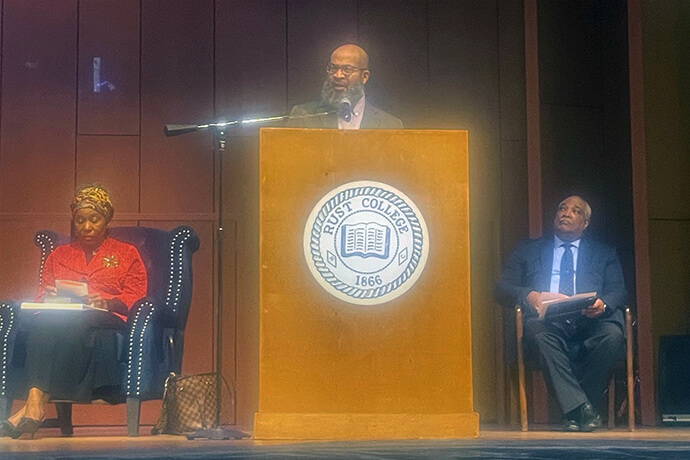
William T. Scott III, a retired chemistry professor at Rust College and the University of Mississippi who has held leadership positions in the Mississippi Conference, said that five years ago, he might have suggested “we slack off” on calling attention to racism in America.
“You ask me that today, and I have to say, ‘Hell yes, we need to be doing this.’
“Getting mishandled by police, our elected officials not willing to even discuss voter registration, not willing to discuss criminal justice systems, not willing to discuss economic improprieties,” he said. “We’re back almost further than we were when I was a student growing up here at Rust College in 1964. … We knew where we were going. We knew that the Justice Department and … Supreme Court were all moving in the same direction.
“And now, you don't know any of that.”
Rust, a small, traditionally Black and United Methodist-associated institution, hosted the second of five Freedom Trail Revival events on March 2. The first was Feb. 3 at First United Methodist Church of Greenwood, and still to come are April 6 at Wells Memorial United Methodist Church in Jackson; May 4 at St. Paul United Methodist Church in Hattiesburg; and June 15 at Gulfside Assembly in Waveland.
During the March event, the Rust College A’Cappella Choir sang three numbers.
The Rev. Cynthia Davis, executive vice president and director of the Moore-West Center for Applied Theology in Memphis, Tennessee, preached on “Here I am. Send me.” — a theme from the book of Isaiah.
Subscribe to our
e-newsletter
“I don’t know what your role in the church is, or if you are even a member of a church,” Davis said. “My question is, ‘What is God asking you to do and what is your answer to almighty God?’”
Michael Danahy, a retired language professor at the University of Mississippi, who is white, attended the event and said that “one of the best things about The Methodist Church is they were leaders in the civil rights movement, and I want to learn more about it and hear about it,” he said.
“I think there are forms of racism that are still active,” he said. “The more people (that) know about the Freedom Trail, I think, the better off we’ll be.”
Mississippi’s Freedom Trail was established in 2011 to commemorate the people and places in the state that played an important role in the civil rights movement.
A panel discussion on the topic “Can Racism End in Society?” was the lengthiest program on the agenda. The first question, asking about the root cause of racism, brought forth varied opinions.
“It’s been my experience that religion has been one of the main causes and sources of racism,” said Scott, one of five panelists. “We need to recall that religion is not exercised inside of a vacuum. It’s part of the culture and because there’s slightly different religious differences among people, then people tend to think you’re either better or you’re worse. … There’s a direct relationship between religious practices and racism.”
The other panelists were A.J. Stovall, a political science professor at Rust; the Rev. Erin Beasley, pastor of The Vine United Methodist Church in Nashville, Tennessee, and contributing author of “I’m Black, I’m Christian, I’m Methodist”; Larry Rubin, a civil rights worker and union organizer; and high school student John Barksdale.
“The United States was founded by a bunch of rich white guys who were angry that just because there was an ocean separating them from their brethren in England, they were not allowed to get as rich as their brethren in England,” Rubin said.
“White people in this country felt that they needed to perpetuate slavery to create great wealth, and they came up and perpetuated this false theology of racism to justify it, saying, ‘We have the right to great wealth on the backs of poor people and Black people we are forcing to work at our whim because of inherent differences between races.’”
Bringing up the concept of reverse racism, Stovall said that “Black people do not have the power to inflict racism … on anybody in this country.”
Citing the 1968 Kerner Commission Report to President Johnson, Stovall said that “What white Americans have never understood and Black people can never forget, is that white society is deeply implicated in the ghetto or racism.
“White institutions created it, white institutions maintain it, and white society condones it,” he said, quoting the report.
The murder of George Floyd by a Minneapolis police officer in 2020 was the impetus of the Mississippi End Racism for Good campaign, which in turn spun off the 2024 Freedom Trail Revival.
“(Floyd’s death) really sparked conversation in our conference, like it did in many conferences across the country,” said the Rev. Bruce Case, co-chair of End Racism for Good and pastor of Parkway Heights United Methodist Church in Hattiesburg, in a telephone interview.
Case and Henry were asked by Bishop James Swanson to come up with a plan to increase understanding of racism, “build solidarity … and do better,” Case said.
The campaign began with town hall meetings and “healing circles” to discuss the issue.
“We’ve celebrated heroes and saints in Mississippi who are doing great work in racial justice and in racial reconciliation,” Case said. “We remembered their history and maybe remembered martyrs and heroes that came before us, and we perhaps lamented the pain of that area.”
The next step was to “get people of different races worshipping under one roof,” he added.
There has been resistance to their healing intentions.
“One of the interesting things that second year when we were bringing in people on Zoom and interviewing them, we got hacked by some really overt racist,” Case said.
He called the incident “traumatic … and sad,” noting that the FBI actually got involved.
“There’s always going to be people who really don't like what we’re doing or don’t think it’s necessary or don’t believe that racism exists,” Case said.
Patterson is a UM News reporter in Nashville, Tennessee. Contact him at 615-742-5470 or newsdesk@umcom.org. To read more United Methodist news, subscribe to the free Daily or Weekly Digests.


