
Key points:
- Bishop Samuel J. Quire of Liberia responded to protests following General Conference’s removal of restrictions on LGBTQ people.
- He stressed that The United Methodist Church in Liberia will not conduct any weddings or ordinations of “self-avowed practicing homosexuals.”
- Meanwhile, some Liberian United Methodists are urging the bishop to call a special session to determine whether or not the conference remains in the denomination.
- But a document purporting that the conference will hold such a meeting is not authentic.
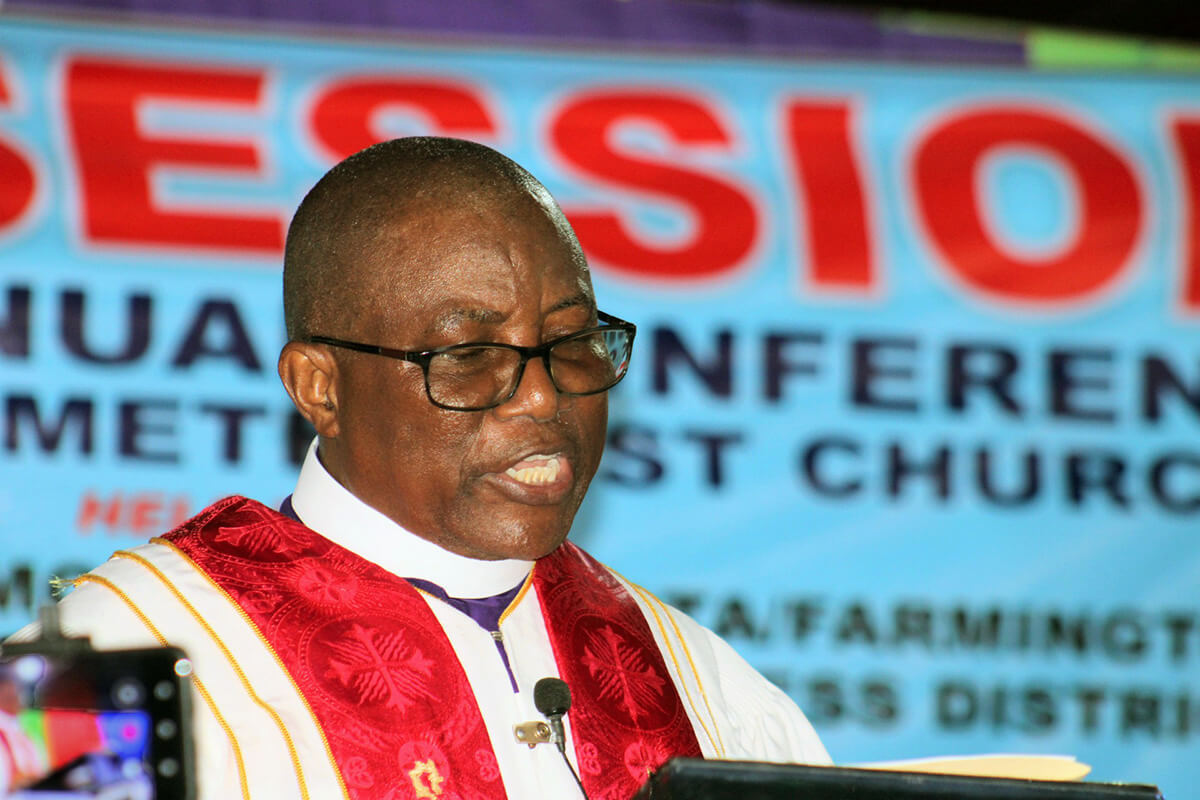
“Be a United Methodist, love The United Methodist Church and stay a United Methodist,” Bishop Samuel J. Quire Jr. urged his fellow Liberian church members at the end of a press briefing aimed at clearing up misinformation.
Quire held the briefing June 7 amid controversy brewing among Liberian church members after the recently concluded General Conference that saw the international policymaking assembly remove denomination-wide bans on same-sex marriage and gay clergy. But Quire emphasized these actions do not alter the Liberia Conference’s own marriage and ordination policies. He also said General Conference made decisions in the interest of the church dealing with the differences among its members.
General Conference’s actions have already sparked protests by some United Methodists in Liberia and Zimbabwe — both countries where same-sex activity is illegal. One Liberian group is pressing the bishop to call a special session of the annual conference so that conference members might vote to leave the denomination. The Côte d’Ivoire Conference held such a vote in May and is now working toward becoming an autonomous denomination, independent of The United Methodist Church.
However, a document being spread around social media purporting that the Liberia Conference will hold a special session is not authentic, said Alfred Kwabena Mensah, one of the leaders of the group calling for the meeting.
Asked if there will still be a protest if the bishop and church leadership do not hold a special session, Mensah said, “we will decide what to do next.”
At this point, the Liberia Conference’s next scheduled session is its regular session in February next year.
In the meantime, Quire used his press briefing to explain what General Conference did and did not do.
Subscribe to our
e-newsletter
“The removal of restrictions on marriage and ordination for self-avowed practicing homosexuals means that those conferences that wish to marry and/or ordain self-avowed practicing homosexuals can do so,” he said in a statement now posted on the Liberia Conference’s website. “It also means that those of us in Africa, and especially for us in Liberia, are free not to allow such marriages and/or ordinations.”
In fact, he pointed out, General Conference also approved explicit protections to allow every United Methodist pastor to refrain from performing any wedding that goes against their conscience.
Since the bishop’s June 7 briefing, some have taken to social media to push for a special session. One of those calls comes from the Rev. George D. Wilson Jr., chairman of the conference’s board of ordained ministry. He posted a letter titled, “A call to prayer and calm for a way forward for the LAC/UMC.”
In the letter, Wilson said the church leadership needed to call a session to deal with concerns coming from the General Conference. The letter also said United Methodists in Liberia need to hear the report from their General Conference delegates and formally take action on the Way Forward Committee report as was decided by the Liberia Conference in February.
Last year, Quire set up the committee, which includes Liberians who want to separate from The United Methodist Church and those who want to remain United Methodist.
Wilson sent a second letter on June 19 to inform clergy and laity that the board of ordained ministry and other church leaders met with the bishop that morning and Quire maintained his stance that he will not call a special session.
In the letter, Wilson also noted that the board would visit each district in the conference along with other leaders and delegates to General Conference to provide a report on action taken at the legislative assembly and to vote on the report of the Way Forward Committee.
The Rev. Caleb S.G. Domah, a leader of the group dubbed “Stay UMC,” said there is no reason to rush with a special session when people are not yet fully educated on regionalization — another possible change coming out of General Conference.
“We need to spend the next seven to eight months educating our people about the decision of the General Conference and how to go about the ratification process,” Domah told United Methodist News.
Quire spoke about regionalization as part of his press briefing.
“The structure of the church has been deeply American ‘centric,’” he said.
Instead, he said, regionalization will empower United Methodist churches and conferences around the world “to make ministry and missional decisions appropriate for their context in order to be more relevant and effective.”
“Since the contextual realities of Africa are different from those of America, Europe and Asia, African conferences will decide what is needed to advance the disciple-making mission of The United Methodist Church in Africa.”
But whether regionalization is ratified or not, Quire said, Liberia will not conduct any weddings or ordinations of gay people.
“The Liberia Annual Conference of The United Methodist Church is traditional in its interpretation of Holy Scripture and will continue its evangelistic outreach to all persons who live in darkness and do not know the redemptive grace of our Lord, Jesus Christ,” he said. “We will continue to extend scriptural holiness to all persons by the amazing grace of God.”
Swen is editor and publisher of West African Writers, an online publication about United Methodist happenings in West Africa.
News media contact: Julie Dwyer at newsdesk@umnews.org. To read more United Methodist news, subscribe to the free Daily or Weekly Digests.


