
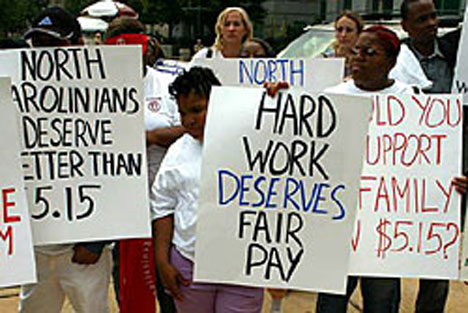
New resolutions adopted by United Methodists touch on a variety of social justice issues, including a living wage, hate crimes and the use of torture.
The resolutions were among the consent calendar items approved by the denomination's General Conference during its April 23-May 2 legislative event at the Fort Worth Convention Center.
The impact of globalization is addressed in a resolution on "Global Living Wage," which calls upon "all members of the global United Methodist Church to work in partnership with persons, communities and governments everywhere around the world to bring about the creation of conditions that encompass fundamental workers' rights, fair wages, a safe and healthy workplace, reasonable hours of work, decent living standards, support for community infrastructure and commitment to community economic development."
Changes in welfare reform since the 2004 General Conference include the Work Opportunity and Personal Responsibility Act, commonly known as Temporary Assistance for Needy Families (TANF) Act, which has a heightened focus on the work mandate as a condition for benefits.
The approved updating of the denomination's resolution on "Principles of Welfare Reform" calls on United Methodists to urge state and county governments "to create programs that assist current and former welfare recipients in making the transition from dependence onto economic health, including: training, public sector job creation, child care and resources for parenting."
Concerns about "The Girl Child" led to a petition advocating the church's active support "to the empowerment of girls in all aspects of life." The focus includes health, education, financial literacy and family environment. "Develop strategies and action plans to build girls' stakes in their societies and to recognize their rights and citizenship at an early age. ...," the petition says.
A petition on "Grieving and Repenting from Acts of Hate and Violence" calls both for education and a variety of action steps, including taking strong nonviolent action in opposition to hate groups, promoting diversity dialogue and programs and encouraging victims of hate crimes to speak up.
"Evangelize those individuals who would choose to be a part of hate groups or who commit acts of hate and violence individually and show them the compassion and saving grace of Jesus Christ," the petition says.
Another petition on "Resisting Hate" calls for biblically-based resources for young people and adults addressing the historic and systemic roots of hate, along with resources "to help United Methodists analyze the language of hate among groups that use religious language to justify hatred and bigotry."
The denomination's annual (regional) conferences are asked to advocate for comprehensive state hate-crime laws, develop databases of information about local and state hate groups and create a task force to develop strategies "to address actions of the media that use or condone hate speech, stereotypes or racial profiling."
An adopted resolution on "The Abolition of Torture" requires The United Methodist Church "to publicly condemn and oppose torture wherever it occurs through legislative and other means." That includes advocating for the ratification of the Convention Against Torture, fully supporting the International Criminal Court and organizing or joining events such as the United Nations International Day to Remember the Victims of Torture on June 26.
"United Methodists should seek access to places of detention and interrogation centers in order to ensure that persons held are not mistreated," it says.
Another resolution on "Opposition to Torture" states that the Geneva Conventions should be applied "to all enemy soldiers" and supports "the humane treatment with due process for all combatants held by both government and nongovernment forces anywhere in the world."
It also calls for "judicial review and legislative oversight over executive branch operations relating to counter terrorism and domestic surveillance programs, both classified and publicly acknowledged."
*Bloom is a United Methodist News Service writer based in New York.
News media contact: Linda Bloom, e-mail: newsdesk@umcom.org; call: (615) 742-5470.
Related Articles
General Conference headlines
Church adopts proposed creed as litany
Resource
Like what you're reading? Support the ministry of UM News! Your support ensures the latest denominational news, dynamic stories and informative articles will continue to connect our global community. Make a tax-deductible donation at ResourceUMC.org/GiveUMCom.


