United Methodist bishops have unanimously endorsed recommendations for widespread church reforms, including greater accountability for denominational leaders in promoting church growth.
The Council of Bishops' approval of the recommendation in the Call to Action Steering Team Report on Nov. 4 was heralded as a step forward for a church that has suffered decades of membership decline in the United States.
"What this means is that whatever goes forward, the council is committing itself and hopefully the Connectional Table will make the same commitment that yes, we are taking a stand and these are the levers to pull the church in the direction in which we feel the Spirit of God is calling us," said Illinois Area Bishop Gregory V. Palmer, the steering team co-chair. "And that is toward more congregational vitality."
The major recommendations for reform include:
- Starting in January 2011, make congregational vitality the church's "true first priority" for at least a decade.
- Dramatically reform clergy leadership development, deployment, evaluation and accountability.
- Collect statistical information in consistent and uniform ways for the denomination to measure attendance, growth and engagement.
- Reform the Council of Bishops, with the active bishops assuming responsibility for promoting congregational vitality and for establishing a new culture of accountability throughout the church.
- Consolidate general church agencies and align their work and resources with the priorities of the church and the decade-long commitment to build vital congregations. Also, the agencies should be reconstituted with smaller, competency-based boards.
Some of the recommendations will require the approval of General Conference, the denomination's top lawmaking body. The bishops also supported the creation of an interim operations team, which will be responsible for helping to draft any legislation that will be required.
Drivers of vitality
The Call to Action Steering Team's recommendations go next to the Connectional Table, which will next meet on Nov. 15 in Franklin, Tenn. The Connectional Table helps guide funding of denominational operations, including the work of the proposed operational team.
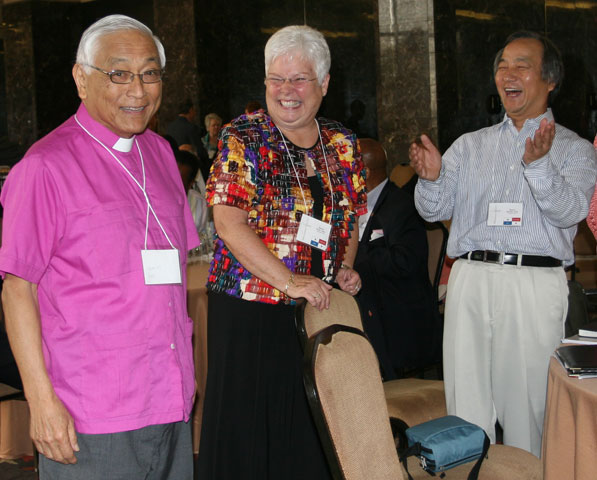
Raleigh (N.C.) Area Bishop Alfred W. Gwinn Jr. requests a vote on the Call to Action Steering Team's recommendations.
For the past two days, more than 80 active and retired bishops at the Council of Bishops gathering have discussed the steering team's report. In 2009, the council and Connectional Table created the 16-member churchwide advisory group, which includes clergy and laity, to address the decades-long membership decline in the United States.
The Call to Action team based its recommendations on two studies it commissioned from independent researchers. One was an "Operational Assessment of the Connectional Church" that found the church was undergoing a "creeping crisis of relevance" and rated general agencies below average in fulfilling the church's mission.
Another study, "The Vital Congregations Research Project," analyzed data from 32,228 United Methodist churches in the United States and classified 4,961 congregations, or 15 percent, as "high-vital" local churches. The study found that four key drivers of congregational vitality in the United States are effective pastoral leadership, multiple small groups, diverse worship styles and a high percentage of spiritually engaged laity in leadership roles.
Fred Miller, a consultant who helped coach the Call to Action Steering Team, said the finding gets beyond the debates between theological liberals and theological conservatives that have long divided the church.
"In the U.S., we have this struggle for dominance between liberals and conservatives," Miller told the bishops. "The research says that (the theological orientation) doesn't make a difference for having vital congregations. The research says that's that not how we draw confessions of faith."
Miller is the president of The Chatham Group consulting firm and a member of First United Methodist Church in Chatham, Mass.
Greater accountability
The studies had a U.S. focus, and some bishops questioned whether the drivers of vitality would be as effective outside the United States. Still, many of the bishops from other parts of the world applauded the report's recommendations particularly the call for greater accountability.
"It's time for us as bishops to stand up and do this," said Zimbabwe Area Bishop Eben K. Nhiwatiwa. "Let us make this happen."
Not every recommendation requires action by the bishops or the General Conference. Local churches can work on the drivers of vitality now, said team members.
Palmer acknowledged that church leaders have made similar recommendations before with the goal of improving church vitality. And some church members have criticized the report as the "same old, same old."
"There has not always been sustained attention and organizational follow-through on good things that have been initiated," Palmer said. "I think people are rightfully concerned about the church's attention span."
Still, he said, he is optimistic this is the beginning of a new thing in the denomination.
"I feel as though this council is digging in sustained focus and, hopefully, we will stick with it as long as it has been suggested, which is at least 10 years."
*Hahn is a multimedia news reporter for United Methodist News Service.
News media contact: Heather Hahn, Nashville, Tenn., (615) 742-5470 newsdesk@umcom.org.
Related Articles
Bishops urged to embrace change
Call to Action report: Reform church in U.S
Call to Action offers signs of crisis and hope
Call to Action seeks to increase church vitality
Connectional Table OKs new plan to study church
Committee assesses life of church
Resources
Call to Action Steering Team Report
Call to Action - Reordering the Life of the Church
Call to Action - The Assignment
Like what you're reading? Support the ministry of UM News! Your support ensures the latest denominational news, dynamic stories and informative articles will continue to connect our global community. Make a tax-deductible donation at ResourceUMC.org/GiveUMCom.


