
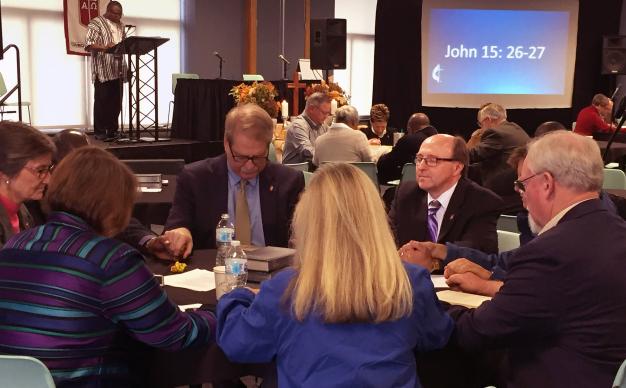
United Methodist bishops are exploring three possible models for how the church should handle LGBTQ inclusion.
The models come to the bishops from the Commission on a Way Forward, which has the task of trying to find a way for the church to stay together despite deep divides over homosexuality.
The bishops have been meeting in closed session Nov. 6-9 to discern whether the commission is heading in the right direction. The bishop-appointed commission has three more meetings planned early next year, and the bishops do not plan to develop any final recommendations until May 2018.
The possibilities under consideration:
- Affirm the current Book of Discipline language and place a high value on accountability. The church policy book says the practice of homosexuality “is incompatible with Christian teaching” and lists officiating at a same-gender union or being a “self-avowed practicing” gay clergy member as chargeable offenses under church law.
- Remove restrictive language and place a high value on contextualization. This sketch also specifically protects the rights of those whose conscience will not allow them to perform same-gender weddings or ordain LGBTQ persons.
- Create multiple branches that have clearly defined values such as accountability, contextualization and justice. This model would maintain shared doctrine and services and one Council of Bishops.
Each possibility includes a way to exit for those church entities that feel called to leave the denomination.
In a press statement, the Council of Bishops said, each possible model represents values within the council and across the church.
In its interim report, the commission did not express a preference for any of the models. The bishops, likewise, are not expressing a preference at this time.
Bishops, like the United Methodists they lead, have different interpretations of Scripture and different views of how the church should minister with LGBTQ individuals.
Among those participating in the discussions were bishops whose home countries have outlawed same-sex activity and bishops who advocate for eliminating church restrictions, including Mountain Sky Area Bishop Karen Oliveto — the denomination’s first openly gay episcopal leader.
Still, a number of bishops told United Methodist News Service of feeling a good spirit in the room as they prayerfully considered the church’s future.
“Operate with a heart of peace and an openness,” Bishop Sandra Steiner Ball, one of the moderators, told her fellow bishops, according to the release.
She added that all three models grew out of the commission’s mission, vision and scope.
“Each one of these models connects to a story and experience that is represented in this body,” said Steiner Ball, who also leads the West Virginia Conference.
The commission will process the bishops’ feedback from this week’s discussions. The press statement said the commission also will continue to welcome further input about the possible models from church members, shared through their respective bishops.
The commission plans to share the resources used by the bishops in their conversations at this meeting on its website.
Ultimately, whatever the bishops propose will go before the lay and clergy delegates of a special General Conference on Feb. 23-26, 2019, in St. Louis, Missouri.
Throughout the meeting, the bishops’ worship services have focused on unity.
Bishop Samuel Quire Jr., who leads the Liberia Conference, invoked the power of the Holy Spirit to make a “vibrant church,” “an open church” and “a tolerant church,” during the Nov. 8 service.
“We know that when your Holy Spirit is in control, you will land the ship called United Methodist into safe harbor.”
In her Nov. 9 sermon, Bishop Sharma Lewis — who leads the Virginia Conference — exhorted her colleagues to pray for unity. She also preached that diversity is an essential part of unity.
“We’ve wrestled this week, we’ve been anxious this week, we’ve even been mad sometimes this week, but the question still remains: How do we maintain unity in the midst of disunity?” she preached. “Jesus reveals the oneness. … He prays for oneness with the community, oneness with each other, oneness with God the Father, God the Son and God the Holy Spirit.”
Bishop Bruce R. Ough, the Council of Bishops president, also asked all United Methodists to pray.
“Pray for the work of the commission and for the bishops as they continue to discern God’s plan for the future of the UMC,” Ough said in the press statement, “a future that shows love for all of God’s people and a future with hope.”
Hahn is a multimedia news reporter for United Methodist News Service. Contact her at (615) 742-5470 or newsdesk@umcom.org. To read more United Methodist news, subscribe to the free Daily or Weekly Digests.
Like what you're reading? Support the ministry of UM News! Your support ensures the latest denominational news, dynamic stories and informative articles will continue to connect our global community. Make a tax-deductible donation at ResourceUMC.org/GiveUMCom.

