
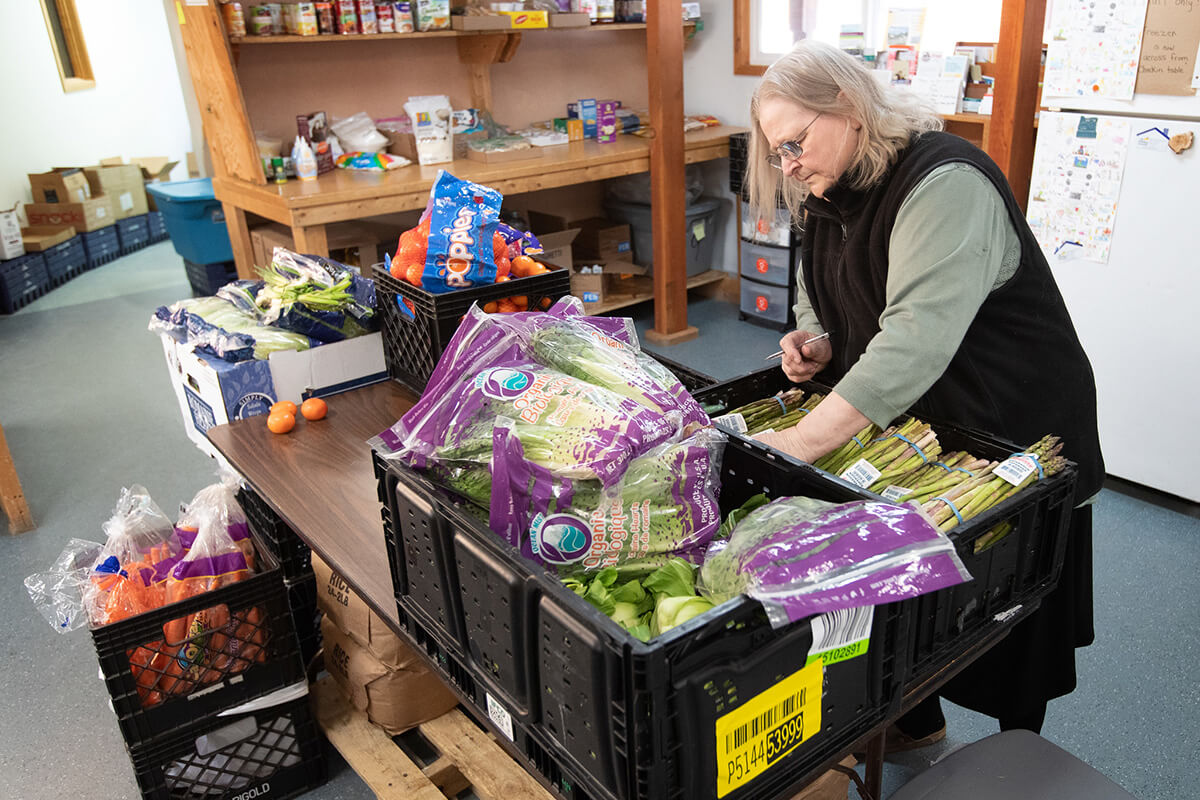
Faced with a hunger crisis in the U.S., The United Methodist Church’s mission agency is stepping up to help keep church food pantry shelves from going empty.
The United Methodist Board of Global Ministries announced Oct. 30 that it is introducing Feeding Our Neighbors grants, offering up to $2,000 in emergency funding for United Methodist church food ministries and pantries.
The board described the Feeding Our Neighbors program as part of following Jesus’ call in Matthew 25:35: “For I was hungry and you gave me food. I was thirsty and you gave me something to drink. I was a stranger and you welcomed me.”
The new grants program is not the only way United Methodist ministries and churches are seeking to help amid the U.S. government shutdown that began Oct. 1. But the grants are coming at a time of growing urgency with some 42 million Americans losing federal food benefits starting Nov. 1.
Even before the U.S. Department of Agriculture announced plans to halt the Supplemental Nutrition Assistance Program, many United Methodist ministry leaders were reporting needs similar to what they saw during the early days of the COVID pandemic.
“The further loss of food assistance benefits will have devastating consequences for millions of families,” Roland Fernandes said in a statement. He is the top executive of Global Ministries, the United Methodist Board of Higher Education and Ministry as well as the United Methodist Committee on Relief.
Subscribe to our
e-newsletter
“We pray that these grants will help local churches respond quickly and compassionately in their congregations and communities,” he said.
United Methodist congregations seeking to participate in the Feeding Our Neighbors program can apply here through Dec. 15. Up to 50 grants are available. Global Ministries will distribute each grant within three weeks of approval.
In addition to microgrants for churches, Global Ministries is working on a large grant to support Feeding America, the largest hunger-relief organization in the United States. Once finalized and approved by the board of directors, the grant will support Feeding America’s Regional Food Sourcing Initiative, which recovers and redistributes surplus produce, protein and dairy.
With a network of 200 food banks that store food and 60,000 partner food pantries and meal programs that distribute food, Feeding America serves communities in all 50 states, Washington, D.C., and Puerto Rico. Last year, Feeding America distributed 5.7 billion meals.
“It is a tragedy that so many do not have access to nourishing food — whether in our own neighborhoods or across the globe,” Fernandes said. “This grant, once approved, reflects our commitment to expand the impact of our work through a trusted network that has great outreach throughout the United States.”
United Methodist churches also have been stepping up in this time when federal workers are missing their paychecks.
The United Methodist Church of Libertyville in Illinois is distributing Walmart gift cards, each valued at $20, to support active-duty military personnel and their families at the nearby Naval Station Great Lakes. So far, the church has raised more than $1,100 for the effort.
“While small in scale, we hope it offers a bit of encouragement and relief,” the church said in a letter to the Naval Station.
Members of Resurrection, a United Methodist Church, in Leawood, Kansas, have brought pizza and notes of support for air traffic controllers at Kansas City International Airport.
The largest United Methodist church in the U.S. also provides food through its food pantry at its Overland Park location and its mobile food pantry. And the church distributes resources for other food pantries throughout the city.
This is an all-hands-on-deck moment for United Methodists across the U.S., said Rae Lathrop.
She is the director of justice and community development for the Desert Southwest Conference that encompasses United Methodist churches and ministries in Arizona and southern Nevada. Lathrop also played a key role in launching the Desert Spring Community Resource Center, a ministry of Desert Spring United Methodist Church in Las Vegas.
Even before the current crisis, Lathrop said the Las Vegas economy was already sagging amid reduced tourism. She expects communities across the United States will likewise also be hurting with rising job losses alongside increasing prices. Food ministries are critical in this time.
“There are so many different types of food programs — everything from giving a homeless person a bag of something before they can get into a shelter to sustaining what have, in the past, been independent and stable middle-class families,” Lathrop said.
“Every single way in which we distribute resources and support people along the spectrum of need and incomes and class is going to really increase dramatically.”
Food ministries sound alarm on rising needs
Hahn is assistant news editor for UM News. Susan Clark, chief communications officer of the United Methodist Board of Global Ministries, contributed to this story. Contact Hahn at (615) 742-5470 or newsdesk@umcom.org. To read more United Methodist news, subscribe to the free UM News Digest.

