
As United Methodists quietly hold conversations about the denomination’s future — including a potential split — the Connectional Table wants a place at the table.
In a statement to the church, the Connectional Table’s chair and top executive said the denomination-wide leadership body has a role to play in finding “a sustainable peace.”
However, members remain unsure what that role might look like.
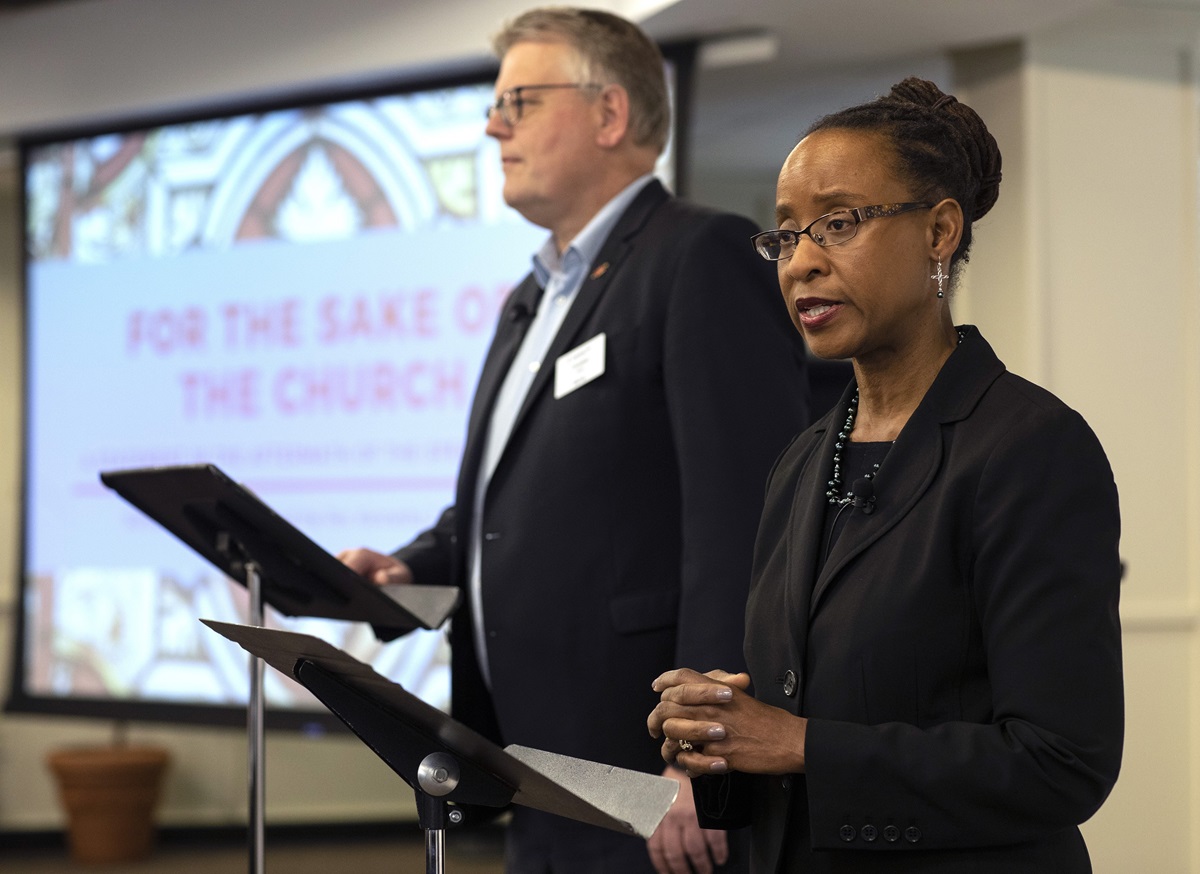
Nordic-Baltic Area Bishop Christian Alsted, Connectional Table chair, and the Rev. Kennetha Bigham-Tsai, chief connectional ministries officer, read their statement to the full body April 3 and then invited members to join in prayer and table conversations about their role.
“As much as we have both worked our entire ministries for the unity of the church, we believe that, because of these fundamental differences, there can be no unity as we have understood and practiced it in the past,” said their statement, which is also translated into French and Portuguese.
“We believe that we need to acknowledge the conversations happening throughout our connection about ways to go forward in ministry, perhaps even along separate paths.”
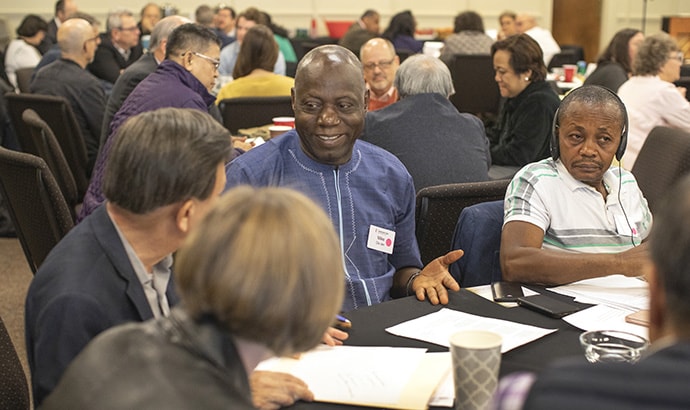
Mike Dio Jen, West Africa Central Conference, shares conversation about stewardship of resources during the Connectional Table meeting held at Discipleship Ministries in Nashville, Tenn., April 3. Photo by Kathleen Barry, UMNS.
The Connectional Table, which has representatives from each United Methodist region in the world, works to coordinate the work of general agencies and the mission, ministry and resources of the denomination. The group is meeting this week to, among other things, prepare the general church budget heading to the 2020 General Conference.
But the 2019 special General Conference remains very much on the group’s mind.
The most recent gathering of the denomination’s top lawmaking assembly by a 54-vote margin approved the Traditional Plan that tightens the denomination’s restrictions on same-sex weddings and “self-avowed practicing” gay clergy. In the weeks since, some United Methodists have expressed relief at the outcome while others have announced plans to resist. LGBTQ members and their allies have also expressed deep pain. Meanwhile, the drumbeat for possibly dividing the church along theological lines has only grown louder.
Alsted and Bigham-Tsai said they envision creating “space that will hold us in the creative tension that can take us forward while preventing the implosion of our denomination into chaos.”
They also challenged the Connectional Table to grapple with the impact of the special session on its own work, especially its role in ensuring missional effectiveness of general agencies.
Some of the Connectional Table members as individuals are already participating in some of the side conversations about the denomination’s future.
Among them is the Rev. Junius Dotson, the top executive of Discipleship Ministries. He spoke in favor of the Connectional Table taking on a bigger role in the discussions.
“This group is one of the few bodies that sees the whole church,” he said.
He added that the Connectional Table has the responsibility to articulate the church’s mission and priorities. “One of the things we can do is articulate the value of general church ministries, not just agencies but what it means to be in connection with each other,” he said.
The Rev. Ole Birch, a member from Denmark, said that while the Connectional Table can contribute to the conversation, he cautioned that the body does not have proportional representation of the global church. Indeed, the meeting included one representative each from the denomination’s central conferences — church regions in Africa, Europe and the Philippines.
The Rev. Lyssette Perez, who represents the denomination’s Hispanic caucus MARCHA on the Connectional Table, said she has so far heard of four possible directions the denomination might take.
These are:
- An amicable divorce where the denomination splits in two without a court battle over property and other assets.
- The creation of an umbrella organization for what are essentially separate bodies, similar to the Connectional Conference Plan that did not gain much traction at GC2019.
- The creation of a U.S. central conference with authority to adapt the Book of Discipline on matters of homosexuality.
- Continued disobedience to church restrictions related to homosexuality with hopes of transforming the denomination in the future.
“All the models have advantages and disadvantages as we think about the future of the church,” Perez said.
Pete Aguila, a Connectional Table member from the Louisiana Conference, said he is not ready “throw in the towel” on the denomination. “We should be part of the solution.”
Dave Nuckols, a member from the Minnesota Conference and Connectional Table treasurer, said the group could provide a reality check about the financial implications of a split.
“If we are going to split, we need a dose of reality in our forecast of how much money will disappear if half of the church leaves,” he said. “There is uneven information around the globe about just what the impact will be.”
Bishop Mike McKee of the North Texas Conference said there is no way for the Connectional Table members to know about or participate in all the conversations happening around the multinational denomination.
But he added that there are probably better conversations happening in the church now about ministering with LGBTQ people than before GC2019 simply because more people are aware of what happened at the lawmaking assembly.
“I would simply say rather than trying to get involved in the conversation, we should find a way to bless them and encourage them,” McKee said.
“There probably is division in this room about what was the desired outcome at General Conference, but the people called Methodist are speaking in new ways that may not lead us to a new place, not a resolution, but a way of moving forward.”
Invitation for feedback
Use the following Google Form to contact the Connectional Table and provide any feedback about this process.
During the morning’s conversation, the body did not come to any consensus about what next steps the Connectional Table might take.
This is the Connectional Table’s last scheduled face-to-face meeting before the 2020 General Conference though other meetings could occur online.
Alsted told United Methodist News Service he thinks members offered a lot of good perspectives. But he said the best way they can serve the church will likely be on an individual basis “but with the knowledge, wisdom and understanding from being part of the Connectional Table.”
After lunch, Connectional Table members heard a Methodist perspective from beyond The United Methodist Church. The Rev. Doug Swanney, connectional secretary of the Methodist Church in Britain, regularly attends Connectional Table meetings.
“Those of us in other parts of Methodist body hold you in prayer during this time,” Swanney said. “The conversations you are having don’t just affect The United Methodist Church, but this has played out in different ways in the whole Methodist family.”
For the sake of God’s mission, not the mission of The United Methodist Church, he said, he hopes church members find “better ways of living with contradictory convictions rather than ignoring voices we’re not quite sure about.”
Hahn is a multimedia news reporter for United Methodist News Service. Contact her at (615) 742-5470 or newsdesk@umcom.org.To read more United Methodist news, subscribe to the free Daily or Weekly Digests.
Like what you're reading? Support the ministry of UM News! Your support ensures the latest denominational news, dynamic stories and informative articles will continue to connect our global community. Make a tax-deductible donation at ResourceUMC.org/GiveUMCom.


