
Key Points:
- The Comics X Theology book club meets once a month in a Washington comic bookstore to discuss how faith and comic book storytelling intermingle with each other.
- The group was founded by the Rev. Jonathan Brown, a comic fan and pastor at Foundry United Methodist Church in Washington, D.C.
- At a recent meeting at Fantom Comics, the group examined Islam through the hit comic novel “Persepolis” by Marjane Satrapi.
The bearded, heavily tattooed man wearing the Wolverine T-shirt was talking about his weekend, which he spent in Atlanta attending Dragon Con.
“Dragon Con is just a big nerd-fest,” said the Rev. Jonathan Brown, who is associate pastor at Foundry United Methodist Church. “‘Nerd Church’ was the early working title of this.”
“This” is Comics X Theology, a book club that meets once a month at Fantom Comics in the vibrant D.C. neighborhood of Dupont Circle. In this club, the texts are comic books — or graphic novels if you prefer a more adult term. They all tie in varying degrees into issues of faith.
The Aug. 31 meeting marked Brown’s return to the group after taking parental leave.
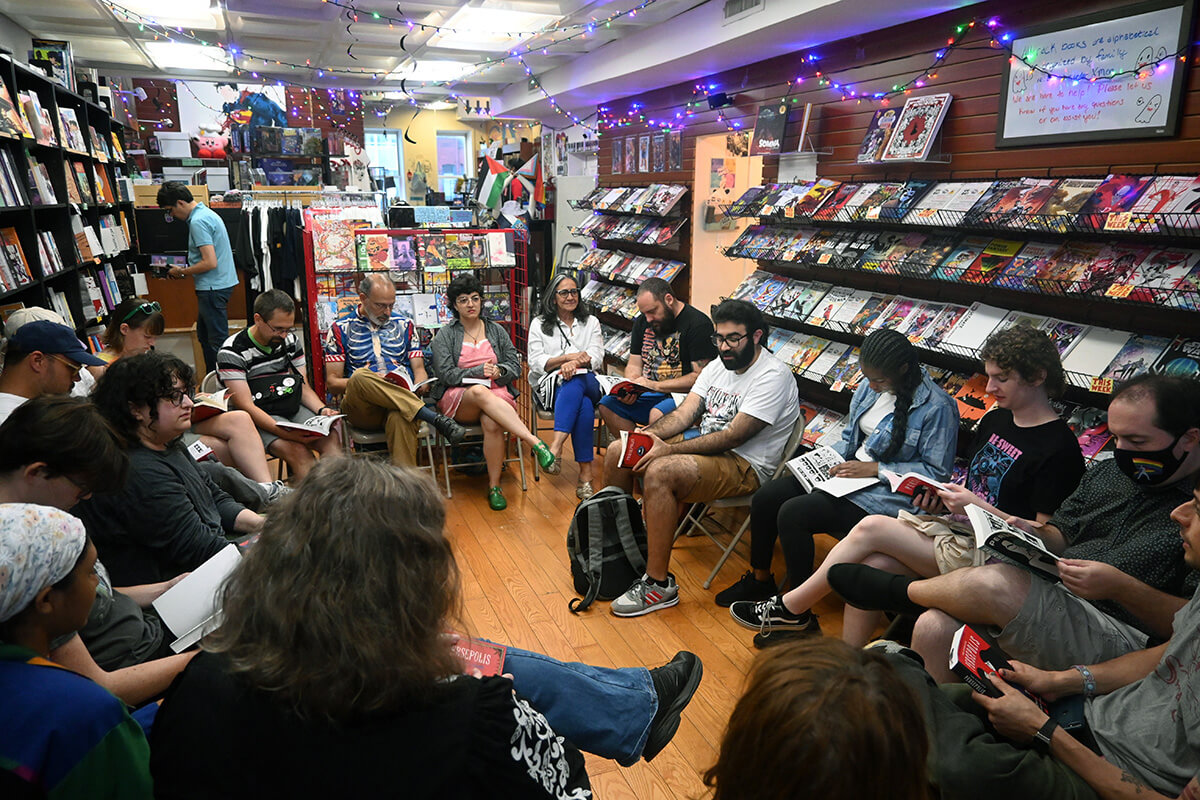
“It’s good to be back surrounded by the art form we all love,” he said at the beginning of the 90-minute group talk. Twenty people participated, seated in a circle and putting up with the occasional customer squeezing past them while shopping.

The diverse group included some curious Foundry members who saw it listed in the church bulletin, a graduate student at United Methodist-related American University, religion believers and skeptics and one “cradle Methodist who has also dabbled in Wicca and Unitarian Universalism.”
Most, but not all, had read “Persepolis” by Marjane Satrapi, the book to be discussed. Some came with a friend or were simply curious.
“Persepolis” recounts Satrapi’s early years in Iran during the 1979 overthrow of the Shah Mohammad Reza Pahlavi and subsequent ascension of Islamic cleric Ruhollah Khomeini. It was a time when soldiers might grab a relative off the street without explanation, and under Khomeini, women again had to cover themselves almost head to toe. Despite the weighty plot, it contains bursts of humor throughout.
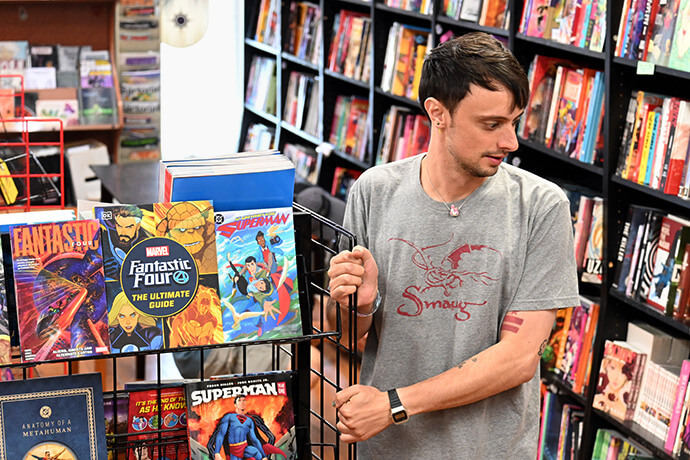
To get the discussion rolling, Fantom owner Jacob Shapiro asked what others thought the book is about.
“To me … this book is about compartmentalization of trauma in a lot of ways,” Shapiro offered. “These people are all getting killed. You got these two panels: ‘The key to paradise was for poor people. Thousands of young kids, promised a better life, exploded on the minefields with their keys around their necks.’
“And then the next panel is, ‘Meanwhile, I got to go to my first party.’”
Other readers offered their takes, which included:
- A story about how it feels to be an alien elsewhere or even at home.
- An examination of how far people go to protect innocence.
- Using gallows humor as a coping mechanism.
- An exploration of hypocrisy.
- Different and sometimes conflicted ways to be rebellious.
- A portrayal of parents maintaining good relationships with their children even when under considerable stress.
- An example of how people sometimes push God aside when bad things happen.
- A statement about how every religion has a variant that oppresses others.
- A warning about the path the U.S. is on, based on what happened in Iran.
“I’ve heard a lot of arguments that America is going down that path of what Iran was going through,” said Tayler Powell, the American University student. “They would want you to feel despair, but finding little pockets of joy is like a form of rebellion.”
During the meeting, one participant said the book “is heartwarming and heart-wrenching at the same time. There are also bits of humor.”
In one anecdote, the family of central character Marji spends a day protesting the government.
“The parents are exhausted because they were out demonstrating all day, and the child wants to start a game of Monopoly,” said the participant. “They’re like, ‘No.’ And then they start laughing. ‘She wants to play Monopoly.’”
Participant M.J. Jean told UM News that she already loved “Persepolis” after reading it years ago.
“I’ve read it several times,” Jean said. “Her experiences are very specific, but there was also a lot of universality in it and there’s a lot of things you can resonate with. … I was never a Middle Eastern woman in a war zone, but I find a kind of hopeful meaningfulness from the book.”
Shapiro said he turned down Brown when first approached to host the meetings.
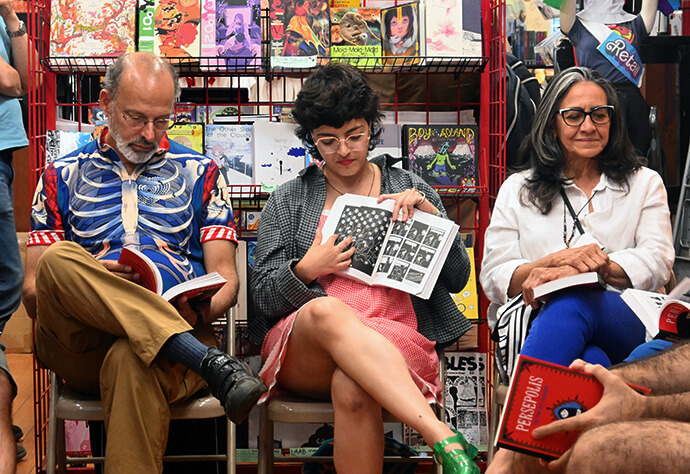
“I knew that it was a great idea, but I wasn’t ready for it yet,” Shapiro said. “We host a ton of events here: book clubs, art workshops, gaming tournaments. … I think that’s sort of the lifeblood of the store because most things we sell, people could buy on their phone. The human community part of it is what makes people care and what makes people come through. So that’s been really integral for us.”
Shapiro said Fantom is a good fit for Comics X Theology because of its “built-in audience of folks who are not just content to read their comfort-food books, but to read things that challenge them.”
Brown got into comics as a kid through “X-Men,” but the character he identifies most with is “Nightwing,” an older version of Robin from the “Batman” comics.
“I remember putting on blankets and running around pretending I was Robin,” he said.
Subscribe to our
e-newsletter
“Both my parents are (United Methodist) pastors. So, here’s this hero that grew up in it, but he found his own path and made his own voice. As someone who went into the same line as their parents, that character was always affirming to me.”
After drifting away from comics, he was reengaged as a college student by a show on The History Channel.
“They were doing a history of comics, and they talked about a run on Green Lantern where it was written by Dennis O’Neil,” Brown said.
Green Lantern comics were not selling well at the time, resulting in O’Neil being told to do whatever he wanted with the title.
“He came in, and he started writing a lot of social justice stuff,” Brown said.
In the first issue written by O’Neil, Green Lantern intervenes when another superhero sweeps in to rescue a man being beat up. The twist is that the victim was a slumlord being attacked by tenants.
“An elderly Black man walks up to the Green Lantern and says, ‘Mr. Lantern, I know you have done so many good things for the blue skins of this planet, the purple skins on this planet. Why have you never done anything for the brown skins?’
“Green Lantern doesn’t have an answer. The Black man says, ‘Well, you got to figure that one out for your own self.’ And walks off.
“It brought me back in as an adult, and since then, I have been reading regularly,” Brown said.
Anna Phillips, who participates in the book group, was brought up in the Catholic Church but does not consider herself religious now. She has been a regular at Comics X Theology, and said it has piqued her interest in religion.
“I noodled around the idea of going to Pastor Jonathan’s church,” she said.
She added that while she’s not in a rush to get back to faith, she’s not nearly as opposed to it as she was “when I was in my more rebellious youth and trying to distance myself from it.
“Seeing all these thoughtful people who do hold faith very close to themselves, but don’t use that as a cudgel against others, that definitely makes it more palatable for me.”
Patterson is a UM News reporter in Nashville, Tennessee. Contact him at 615-742-5470 or newsdesk@umnews.org. To read more United Methodist news, subscribe to the free UM News Digests.

