
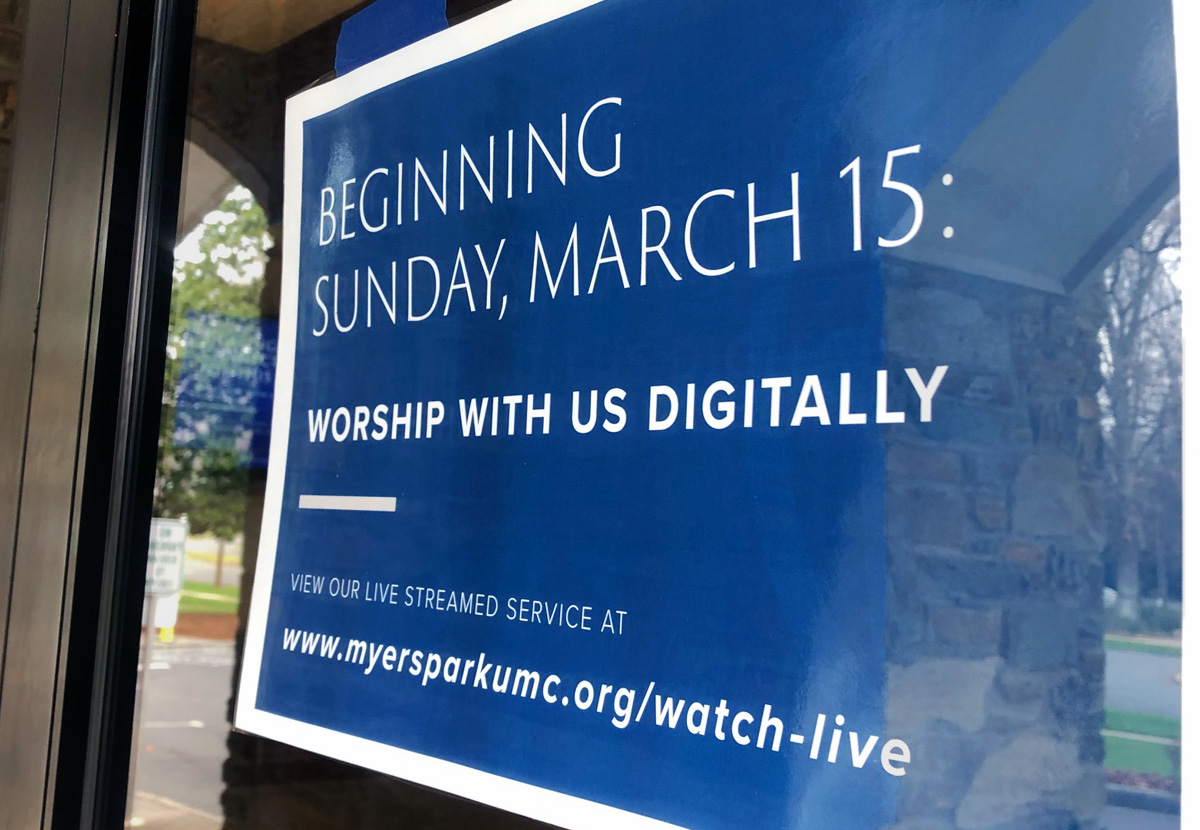
As new developments related to the COVID-19 outbreak emerge, many local United Methodist churches are adapting as fast as they can — promoting preventative hygiene, learning the art of “social distancing” and even temporarily suspending all in-person worship, activities and events.
Sunday worship still is taking place, but increasingly in the virtual world. Even congregations that had not previously attempted to offer an online service are encouraged to give it a go.
And with the pandemic threatening lives around the world, the United Methodist Council of Bishops executive committee is asking for a postponement of General Conference, the top policymaking body and largest global meeting of the denomination, currently scheduled for May 5-15.
Here is a snapshot of how United Methodist bishops, pastors and other church leaders were handling the response to new guidelines and restrictions due to the coronavirus crisis:
In the South Carolina Conference, Bishop L. Jonathan Holston issued a statement about increased vigilance related to the coronavirus outbreak, while also announcing “that at least two members” of a church in the conference had been hospitalized and were being treated for the virus.”
The bishop did not identify the church or the individuals out of concern for their privacy. He said the church’s pastor and two other members “have voluntarily quarantined themselves at home.”
In his statement, Holston still encouraged churches “to proceed with worship services — providing increased vigilance regarding cleaning worship areas, providing hand-washing stations, and educating members about social distancing and other preventive measures.”
He also cautioned church members to base their actions on information from health experts and to share information only from credible sources.
The Pacific Northwest Conference in the Seattle area, one of the epicenters of the U.S. coronavirus outbreak, has been an early adapter in following government health guidelines. In addition, the conference office in Des Moines, Washington, was closed March 9 after a staff member’s spouse tested positive for the coronavirus.
In a new pastoral letter on March 13, Bishop Elaine JW Stanovsky directed “the local churches of any size and other ministries in the states of Alaska, Idaho, Oregon and Washington to suspend in-person worship and other gatherings of more than 10 people for the next two weeks, starting today.” That directive, she wrote, would be updated “as appropriate, but no later than March 24, before Palm Sunday and Holy Week.
A number of churches in the Pacific Northwest Conference started offering online worship on March 8. A quick survey afterward, which drew 20 responses, showed that while 75% had canceled on-site worship, 80% offered online worship and 90% intended to do so the following week.
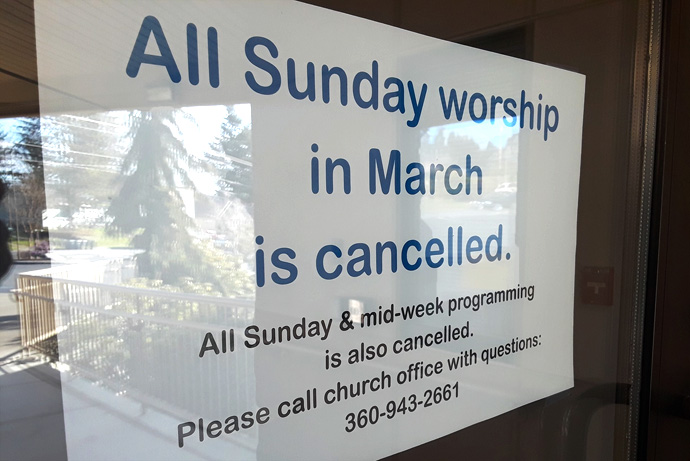
Churches in the Pacific Northwest, such as First United Methodist of Olympia, Washington, are taking strong measures in response to the spread of the coronavirus. Photo courtesy First United Methodist Church of Olympia, Washington.
“We hope that Zoom will serve as a helpful tool for local churches to continue to meet in groups large and small, in worship and other forms of community,” said the Rev. David Valera, the Pacific Northwest’s executive director of connectional ministries.
Social distancing — defined by the Centers for Disease Control as avoiding mass gatherings and maintaining a distance of about 6 feet or 2 meters from others when possible — has become the new buzzword, inside and outside the church.
In North Texas, Bishop Michael McKee asked churches in the two districts that encompass Dallas and its northern suburbs to cancel in-person Sunday services for March 15 and 22. Churches in the two less densely-populated districts could gather if precautions are taken, he said.
“In this moment, the way that we as people of faith can do the most good and do no harm actually is to refrain from coming together,” McKee said in his message to the conference. He advocated for social distancing as the most effective way of slowing the spread of COVID-19.
North Carolina Conference Bishop Hope Morgan Ward shared some words of wisdom about social distancing from Dr. Wes Wallace, an adjunct professor of emergency medicine at the School of Medicine at the University of North Carolina, Chapel Hill, and member of University United Methodist Church there.
“For social distancing to be effective, it must begin early — so early that it may feel unneeded and silly. If we wait until its need is obvious, it is too late,” he said.
Wallace urged churches to temporarily suspend traditional services and gatherings. “The faith community has an important role to play in slowing the speed of disease transmission. Large gatherings of people are a petri dish for spreading the infection.”
United Methodists in countries outside the U.S. are increasing their precautions as well. The Norway Annual Conference has canceled public worship services and all other activities until March 29 and has set guidelines for marriage ceremonies and funeral services, visitation to those who are ill and parish conferences.
Subscribe to our
e-newsletter
Like what you're reading and want to see more? Sign up for our free daily and weekly digests of important news and events in the life of The United Methodist Church.
At least two annual conferences scheduled to meet in March in the Philippines have been postponed.
The Rev. Susan Henry-Crowe, top executive of the United Methodist Board of Church and Society, also addressed the issue of caring for the larger community.
While acknowledging the church’s prudent actions to help minimize the spread of coronavirus, she also “worried about how this pandemic will affect those who are most vulnerable among us.
“I think of low-wage workers who can’t afford to lose a paycheck or the elderly who are more susceptible to the virus,” Henry-Crowe wrote in a pastoral statement. “What does it look like in this moment to stand in solidarity with them? How can we raise our voices as advocates for their needs? How can we remain in community when we are forced to keep social distance?”
Bloom is the assistant news editor for United Methodist News Service and is based in New York.
Follow her at https://twitter.com/umcscribe or contact her at 615-742-5470 or newsdesk@umcom.org. To read more United Methodist news, subscribe to the free daily or weekly digests.
Like what you're reading? Support the ministry of UM News! Your support ensures the latest denominational news, dynamic stories and informative articles will continue to connect our global community. Make a tax-deductible donation at ResourceUMC.org/GiveUMCom.


