
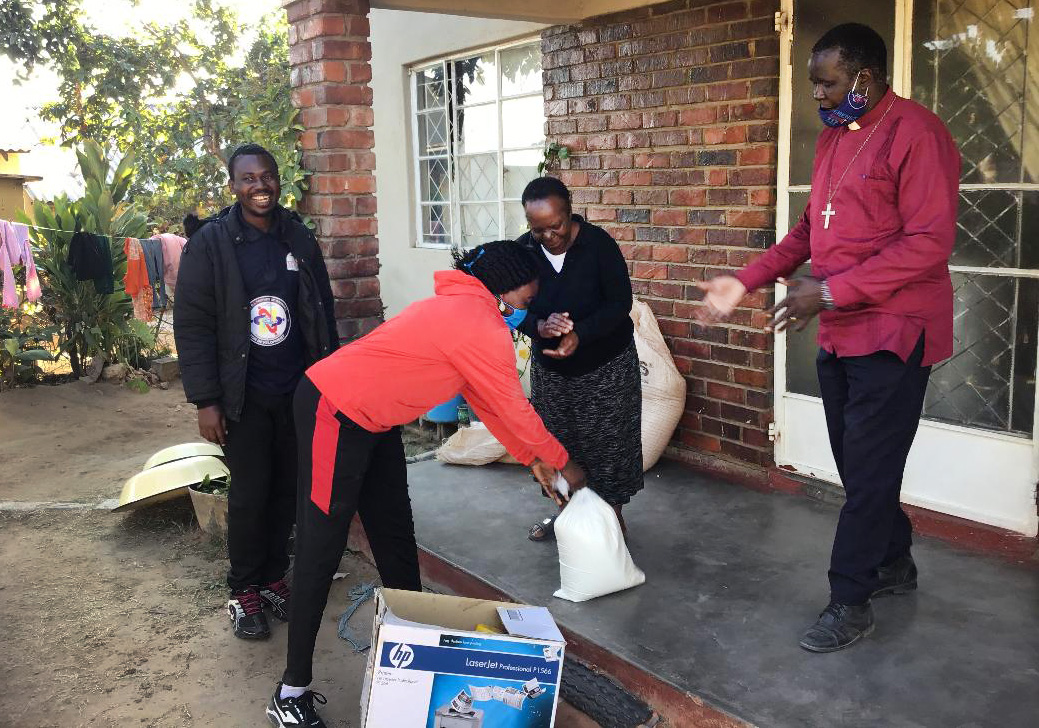
International students at Africa University are sacrificing their own meals to put food on the table in vulnerable communities.
Four theology students at the United Methodist university started the Feed a Family campaign to help families struggling during the COVID-19 pandemic.
The students are among those who remained on campus after AU shifted to online learning in late March. Some of the school’s international students could not afford to return home or their home countries enforced lockdowns and closed their borders and airports.
“Being a student in a foreign country is not easy, but Zimbabwean communities have impacted my life on campus through showing love and care toward me personally,” said Cesar Lodiha Akoka, a Congolese divinity student who helped start the program. “Giving back to the community as students is a way to appreciate the kindheartedness they have presented to us.”
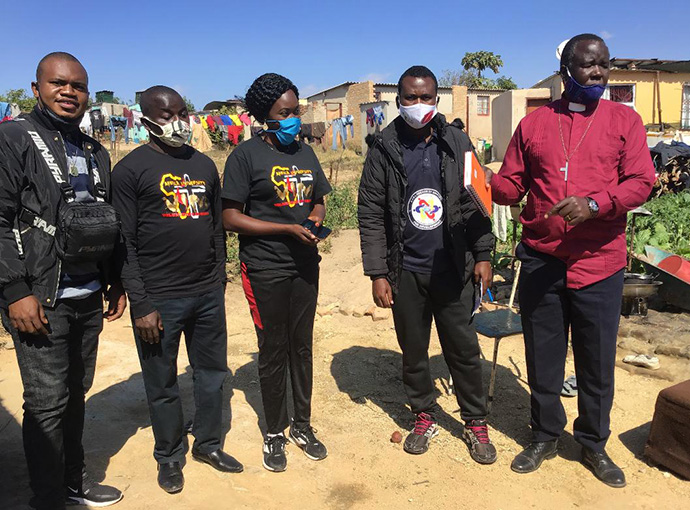
Africa University students Cesar Lodiha Akoka from Congo (from left), Barde Danjuma from Nigeria, Everlyne Kukah Esther from Kenya, Fiston Okito from Congo and the Rev. Joseph Charinge gather before distributing food to families in Gimboki, Zimbabwe, a preaching point community of St. James Dangamvura United Methdoist Church. Charinge, pastor of Gimboki UMC, said the Feed a Family campaign started by the students has resulted in six people joining his church. Photo by Chenayi Kumuterera, UM News.
Everlyne Kukah Esther from Kenya, president of the East Africa Students Association and Africa University’s Volunteers in Mission, said she challenged her fellow students to skip at least one meal a week and donate the money saved to the campaign.
“If you can afford three meals a day, sacrifice one and eat two. If you can afford two meals a day, eat one and donate one. And if you can afford one meal a day, please eat for six days and donate for one day. You will not die. There is someone somewhere who is in a situation which is more serious than yours. (That) has been our song,” said Esther.
The Feed a Family program was launched in collaboration with the Institute of Theology and Religious Studies and Students Representative Council. With the help of United Methodist pastors, Esther said, the students were able to identify people — members and non-members — who needed help.
More than 110 families, many of them headed by children or the elderly, have benefitted from the program, which includes distribution of food, toiletries and money.
Esther said students from East Africa, Angola, West Africa and Congo are among those who have donated money to the program. The university’s farm manager also donated food for the campaign, and the school provides transportation and support on delivery days.
Akoka said he was moved to action by something he saw on social media.
“I saw a woman boiling stones just to give hope to starving children. I became restless,” he said, adding that he wondered how many people were in similar situations nearby.
According to an urgent call to action from the United Nations, which was shared with The Associated Press ahead of publication in the Lancet medical journal, hunger linked to the coronavirus is leading to the deaths of 10,000 more children a month over the first year of the pandemic.
Fanita Vhiyaji, a beneficiary of the Feed a Family program from Berry Farm at Old Mutare, said the outreach has given families hope.
She said she received clothes, food and love through the program. “I have a granddaughter … who needs attention from the doctor frequently, and these students have given life and hope to her.”
Josi Musiyazvi, a beneficiary from the Tsvingwe community in Penhalonga, Mutare, said she was impressed by the students’ willingness to give up their own meals for those who have no food. “They evangelized in my life in a unique way,” she said.
Subscribe to our
e-newsletter
The Rev. Joseph Charinge, pastor at Gimboki United Methodist Church, a preaching point of St. James Dangamvura United Methodist Church, said he attributes six new members to the program.
“These students are doing a very good job in evangelizing … They don't target only United Methodist church members but those in need. This has helped my evangelism,” he said.
He also noted that the students are making sure the beneficiaries observe social distancing protocols to keep everyone safe.
Ugandan Sserunjogi Isaac Clinton, who helped start the program along with Esther, Akoka and Barde Danjuma from Nigeria, said that while the project has helped others, it also has boosted his interpersonal and managerial skills.
The program is fitting for those studying theology, said the Rev. David Bishau, director of the Institute of Theology and Religious Studies at Africa University.
“Being theology students training to be pastors, and some who are already pastors, it was logical for them to immediately think of their role during the COVID-19-induced lockdown as that of alleviating want, especially among the vulnerable people.”
He said students in other colleges, such as health, agriculture and natural resources, immediately focused on people’s health and started making sanitizers and face masks to prevent the spread of the virus, but theology students turned to people's well-being and put food on the table.
“Our aim is to instill hope and help people see Christ in our action,” said Akoka. “The community has to see the church as a caring agent both in words and in deeds. Preaching and action — that is why we are working with pastors. Above all, extend the love of God to them. As we eat, they should also have something on the table.”
Kumuterera is a communicator in Zimbabwe. News media contact: Vicki Brown at (615) 742-5470 or newsdesk@umnews.org. To read more United Methodist news, subscribe to the free Daily or Weekly Digests.
Like what you're reading? Support the ministry of UM News! Your support ensures the latest denominational news, dynamic stories and informative articles will continue to connect our global community. Make a tax-deductible donation at ResourceUMC.org/GiveUMCom.
